What to Look for in Top AI Integration Services for Business Operations
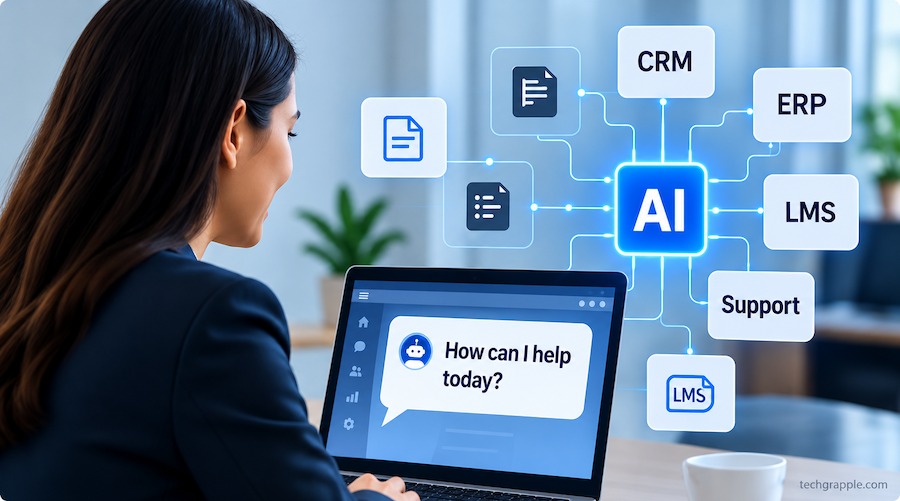
Most companies already have an AI demo somewhere. A chatbot that answers questions from a PDF. A proof of concept built during a hackathon. A pilot that impressed leadership and then stalled when it came time to connect it to actual systems.
The prototype worked. Everyone in the room liked it. Then the question came up about how it connects to the CRM, and the project sat there for six months.
The problem was never the model. It was everything around it. Customer data spread across five systems. Access rules that differed by department. A model that gave sensible answers in testing and strange ones the moment real users typed something unexpected.
None of that shows up in a demo. All of it shows up in production.
What AI Integration Means
The systems a business already runs were built for humans, not for models. A CRM holds customer records. An ERP tracks inventory and finance. An LMS manages courses and learners. None of them were designed with the idea that a language model might need to pull structured data from them at query time.
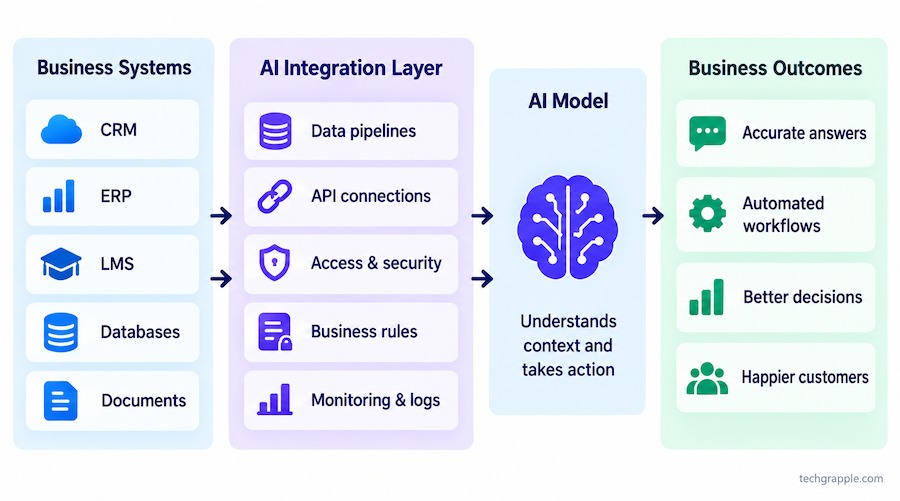
AI integration is the layer that makes those connections work. It sits between the model and the systems, handling the jobs the model cannot do on its own:
- Pulling records from source systems, cleaning them, and delivering them in a format the model can use
- Building the API calls that let the model reach external services and return results to the right place
- Enforcing access rules so the model only sees what each user is permitted to see
- Tracking performance and rolling back changes when something breaks
- Keeping the audit trails and logs that compliance teams need
Without that layer, the model has nothing to work with.
Why Pilots Stall
The gap between a working prototype and a deployed system is where most AI projects fail. The reasons tend to repeat.
Data is scattered
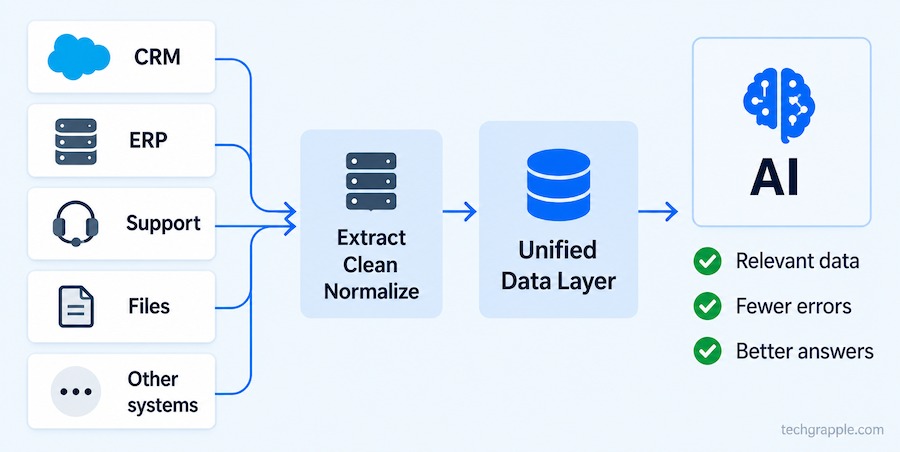
Models need connected, structured data. When customer records live in one system, transaction history in another, and support tickets in a third, the model cannot access what it needs without a pipeline that unifies them.
Providers offering AI integration services often find this step takes longer than the model work itself. Building the pipeline is what makes the rest possible.
Business rules change
A model that hardcodes company policy into its prompts breaks the moment the policy changes. The better architecture separates business logic from the AI layer. The model queries external systems at runtime, so rule updates get picked up automatically.
Nobody owns production
A prototype can run on someone’s laptop. A production system needs deployment pipelines, monitoring dashboards, rollback procedures, and someone on call when things break. That operational layer is easy to underestimate.
Hallucinations were not planned for
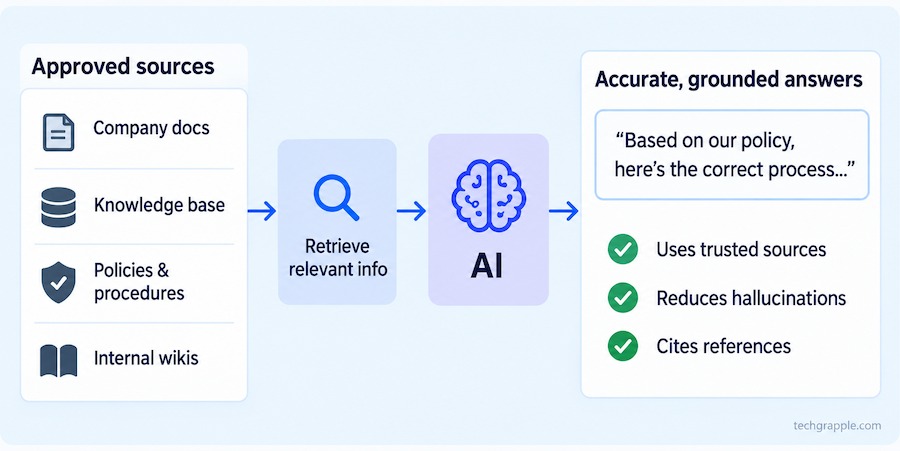
In controlled testing, a model that occasionally invents an answer looks like a curiosity. In production, it becomes a compliance problem. Systems that operate on approved knowledge sources with strict retrieval rules handle this better than systems that rely on the model’s training data alone.
What the Integration Layer Includes
A complete AI integration covers several components. Most projects need at least four of them.
- Data pipelines. Records come out of one system, get cleaned up, and land somewhere the model can actually use them. Extraction, deduplication, normalization, storage. A strong model fed messy data will still produce answers nobody trusts.
- Retrieval systems. For applications that need to answer questions from company documents or databases, a retrieval-augmented generation pipeline connects the model to approved knowledge sources. The model pulls relevant passages at query time rather than relying on training data.
- AI agents and workflows. Agents call APIs, pull records, update systems, and work through tasks that used to take several steps by hand. Document review, ticket triage, approval routing. Where an action touches money or compliance, a person checks the work before it goes through.
- Model and platform selection. Different use cases call for different models. A simple classification task may run on a smaller, cheaper model. A complex reasoning task may need a frontier model. The integration layer handles the routing.
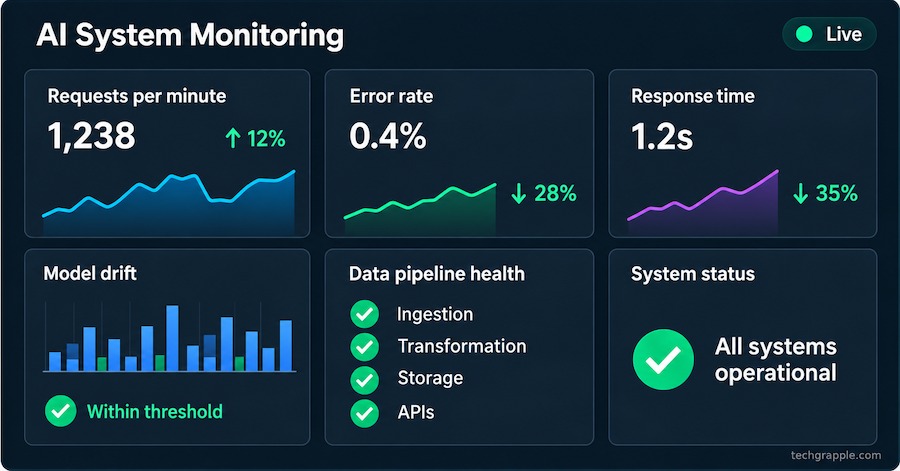
- Monitoring and MLOps. Production systems need performance tracking, drift detection, retraining pipelines, and rollback procedures. Without these, a model that works at launch degrades silently over weeks.
Where AI Integration Projects Break
The failures cluster around a few predictable points.
- Skipping the data layer. Teams that jump straight to model selection without cleaning and connecting their data end up with a system that cannot access what it needs. Fixing this after the fact costs more than doing it first.
- Treating the model as the deliverable. A model is one component. The integration, the monitoring, and the operational procedures are what make it usable. Projects that focus on the model alone tend to stall before deployment.
- Treating compliance as an afterthought. Banks, insurers, and healthcare providers operate under rules about who can see what and where data is allowed to sit. Those rules shape the build. Try to bolt them on after the system is running and large parts of the integration layer have to come back out.
- No plan for model changes. Models get updated. APIs change. A system that assumes static model behavior will break. The integration layer should be able to swap models or update prompts without a full rebuild.
What to Check Before Committing to a Build
Several questions separate providers who deliver production systems from those who deliver impressive demos.
Start with the data
Records arrive incomplete, duplicated, or split across systems that do not talk to each other. Ask what the provider does about that. A team that treats cleanup as a separate phase from the integration tends to leave the worst of it for whoever inherits the build.
Find out where the rules live
If a policy change means retraining the model or rewriting the prompts, the setup will not survive its first update. The stronger builds keep business rules outside the model and pull them in when the request comes through.
Ask what happens after week one
Which metrics does the provider track? How do they catch drift? What triggers a rollback? Answers that stay at the level of “we set up dashboards” are usually a sign the monitoring plan was never written down.
Check how compliance fits in
A bank cannot use the same data access rules as a retailer. A healthcare provider has to know where every record lives. Those constraints come up during design, not after launch.
When a provider treats them as settings to adjust later, the rebuild ends up costing more than the system itself.
Look at the exit plan
Some firms hand off the system and move on. Others stay through the first months of live traffic. Which one fits depends on the internal team, but the answer matters before anyone signs.
Matching the Approach to the Problem
Not every AI integration looks the same. A document processing system for a financial firm has different requirements from a recommendation engine for a retail platform.
- Repetitive workflow automation. The work is connecting the model to existing systems and deciding which exceptions need a person. Success looks like fewer hours spent on the task and fewer errors landing in the queue.
- Customer-facing AI features. The priorities shift to speed, personalization, and keeping the model from saying something it should not. Success shows up in engagement and how many support tickets stop getting filed.
- Data analysis and reporting. The pipeline is where things slow down, not the model. Query performance and how well the system handles volume decide whether anyone can actually use it. Success shows up in how quickly and how accurately the insights arrive.
- Applications within regulated industries. Controls, audits, and data locality are no longer an afterthought. Success equals getting through the audit process without a laundry list of changes that need to be made afterward, as well as maintaining users’ faith in the system’s behavior.
The right partner knows which of these the project actually is. A provider who treats them all the same will miss the part that mattered.
Bottom Line
The model gets the attention. The engineering around it decides whether anyone actually uses it.
Teams that reach production tend to have done three things before launch. They built the data layer first. They kept business logic outside the model. They planned monitoring while the system was still on the whiteboard.
Teams that stall usually skip one of those steps and discover the gap six months later.
When comparing providers for enterprise AI integration, spend less time on the model question. Ask what happens after the model gets picked. That is where the work lives.