
Funded Account Prop Firms Reality: Why So Many Rules, Payout Denials, News Trading Bans & Copy-Trading Restrictions Exist
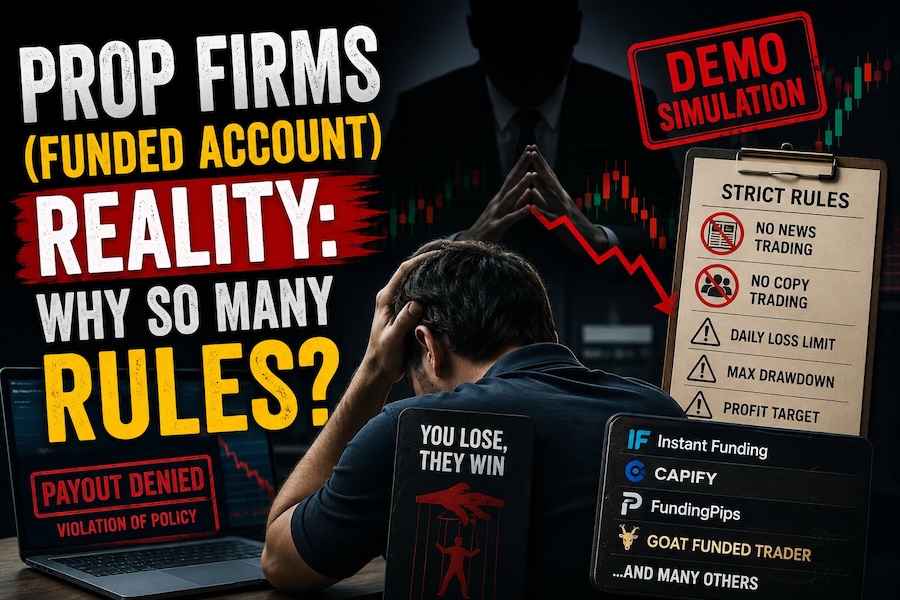
Funded account prop firms look simple from the outside: pay a fee, pass a challenge, receive a large trading account, keep a big share of the profits. The marketing sounds exciting, especially when you see phrases like “trade $100,000,” “instant funding,” “one-step challenge,” “two-step challenge,” “up to 90% profit split,” or “get paid on demand.” But the real picture is much more complicated.
Many traders enter this world thinking they are being given real capital in the same way a traditional proprietary trading desk would back a professional trader. In many modern retail prop firm models, that is not always what is happening. A large part of the industry works through simulated trading accounts, evaluation fees, strict risk rules, payout reviews, and profit-sharing promises. In simple words, the trader may be trading on a demo-style environment, while the firm decides whether the trader is eligible for a reward based on the firm’s own rules.
This is why so many traders ask the same question: Why do prop firms have so many rules? Why no news trading? Why no copy trading? Why no signals? Why consistency rules? Why daily drawdown? Why max floating loss? Why minimum trading days? Why payout reviews after the trader has already made profit?
The uncomfortable answer is this: rules are not only about risk management; rules are also part of the business model. Some rules are reasonable because real markets have slippage, volatility, liquidity problems, and abuse risk. But some rules can also work like filters that reduce how many traders reach payout, reduce how much profit is counted, or give the firm a reason to review, delay, adjust, or deny a payout.
This article explains the reality of prop firms, funded accounts, instant funding programs, one-phase challenges, two-phase challenges, news trading restrictions, copy trading bans, signal-provider problems, and payout denial complaints. The goal is not to target individual companies. The goal is to show traders how the model works so they can read any rulebook with more caution.
What Is a Funded Account Prop Firm?
A funded account prop firm is a company that offers traders access to a large trading balance after they pass an evaluation or purchase a program. The trader does not usually deposit the full account size. Instead, the trader pays a smaller fee to access a challenge or account. If the trader follows the rules and makes profit, the firm may pay the trader a percentage of the profit, often called a profit split or reward.
For example, a trader may pay a fee for a $50,000, $100,000, or $200,000 account. The account size sounds large, but the trader is not normally allowed to lose the full amount. A $100,000 account may have a maximum loss limit of 6%, 8%, 10%, or another number. That means the real risk space is much smaller than the headline balance.
This is one of the first things new traders misunderstand. A “$100,000 funded account” does not usually mean the trader has $100,000 of free capital to trade however they want. It usually means the trader has access to a rule-based account with strict loss limits, trading restrictions, payout conditions, and monitoring.
The Big Difference: Traditional Prop Trading vs Retail Funded Accounts
Traditional proprietary trading and modern retail funded-account programs are often mixed together, but they are not the same thing.
In a traditional prop trading firm, the company hires or backs skilled traders, provides infrastructure, manages real market risk, and may put real firm capital behind the trader. The trader is usually selected through interviews, training, track record, or professional assessment.
In the modern online funded-account model, the firm often sells evaluation challenges to thousands of retail traders. Many traders trade in a simulated environment. If they pass, they may receive another account that is still simulated, or the firm may decide internally whether to copy some trades to a live account. The trader usually cannot verify exactly how much real market exposure exists behind the scenes.
| Point | Traditional Prop Trading | Modern Retail Funded Account Model |
|---|---|---|
| Selection method | Hiring, interview, training, track record, internal testing | Paid challenge, instant funding account, one-step or two-step evaluation |
| Capital | Often real firm capital | Often simulated capital, especially during evaluation |
| Revenue source | Trading profits, desk performance, institutional activity | Challenge fees, account fees, resets, add-ons, sometimes profit-sharing economics |
| Trader relationship | Professional trader or contractor relationship | Customer buying access to a rule-based trading program |
| Main risk to trader | Job loss, profit split reduction, desk limits | Failed challenge, account breach, payout review, denied or reduced reward |
The Reality: Many Funded Accounts Are Simulated
One of the biggest realities traders must understand is that many retail prop firm accounts are not the same as trading a real brokerage account with real money in the market. The account may look real, the chart may move like a real chart, and the platform may feel like normal trading, but the orders may not actually be going to the live market.
This matters because the business incentives become very different. If the trader loses in a simulated account, the firm may not lose real market money. The trader simply fails the challenge or breaches the account, and the fee is already paid. If the trader wins and requests a payout, that payout becomes a cost to the firm unless the firm has successfully copied, hedged, or monetized that trader’s activity elsewhere.
This does not automatically mean every prop firm is fake or every funded account is a scam. Some firms may operate more responsibly than others. Some may have clear rules, fast payouts, and transparent systems. Some may copy good traders to live accounts. Some may treat the simulated model as a risk filter before giving real capital. But from the trader’s side, the key problem is this: you usually do not control or verify the firm’s internal risk model.
Why Do Prop Firms Have So Many Rules?
Prop firm rules exist for two main reasons. The first reason is legitimate: the firm wants to control risk. The second reason is more controversial: rules can also protect the firm’s payout economics.
If a firm gives thousands of traders access to large simulated balances and promises to pay rewards, the firm must prevent behavior that could create large payout claims. News spikes, copy-trading groups, signal trading, one-lot gambling, latency arbitrage, high-frequency trading, weekend gap betting, and all-or-nothing trades can produce fast profits. From a trader’s view, profit is profit. From the firm’s view, fast simulated profits can become a payout liability without creating matching real trading profit for the firm.
That is why funded account rules often go far beyond normal risk management. A trader may be profitable but still fail because the path to profit did not match the rulebook.
Common Rules in Funded Account Prop Firms
- Daily drawdown: The maximum amount you can lose in one trading day.
- Maximum overall loss: The total loss allowed before the account is breached.
- Trailing drawdown: A moving loss limit that follows your equity or balance upward.
- Profit target: The percentage you must gain to pass an evaluation phase.
- Minimum trading days: A rule requiring activity across several days.
- Consistency rule: A limit on how much profit can come from one day or one trade.
- Maximum lot size: A cap on position size.
- Maximum floating loss: A limit on unrealized loss while trades are open.
- News trading restriction: Limits around high-impact news such as CPI, NFP, FOMC, interest-rate decisions, and speeches.
- Weekend holding restriction: Limits on holding trades through market close and gap risk.
- Copy trading restriction: Rules against copying signals, trade ideas, other traders, or unrelated accounts.
- EA and bot restrictions: Limits on automation, third-party robots, HFT, latency arbitrage, tick scalping, and other strategies.
- IP and device rules: Reviews for account sharing, third-party management, or multiple traders using the same setup.
- KYC rules: Identity verification before payout.
Some of these rules are clear and measurable. Others are vague. The vague rules are the dangerous ones because they can be interpreted after the trader is already profitable.
The Real Business Incentive: Fees Are Guaranteed, Payouts Are Conditional
The fee you pay to buy a challenge is real. The reset fee is real. The add-on fee is real. The upgrade fee is real. The payout, however, is conditional. It depends on profit, time, verification, platform data, rule interpretation, and the firm’s review process.
This creates an imbalance. The trader pays first and hopes to qualify later. The firm receives money upfront and only pays if the trader survives all conditions. In a simulated model, when most traders fail, the firm can earn from fees without taking the same market loss that a real broker or live prop desk would face.
This is also why high-profit strategies create tension. If the account were truly trading real capital, a trader making strong profit could benefit both sides: the trader might keep 70% to 90% of the profit, while the remaining share would go to the firm. In a mostly simulated model, the situation is different. The firm may not receive real market profit from the trade, so the trader’s payout can come directly out of the firm’s fee-based economics. That gives the firm a reason to restrict the exact behaviors that can create quick, large payout claims.
This is why many traders feel that some firms want traders to lose. A more careful way to say it is: the business model of many funded account programs can benefit when a large percentage of traders fail, reset, or never reach payout. That is different from proving that every firm intentionally cheats traders. But it is enough reason for traders to be cautious.
A good prop firm should make money because it finds and supports skilled traders. A weak or dangerous prop firm may depend too heavily on failed challenge fees, resets, add-ons, and payout filters.
Instant Funding vs One-Phase vs Two-Phase: Is One Safer?
Many traders think instant funding is better because there is no long evaluation. Others prefer one-phase or two-phase because the fee may be lower or the rules may look more familiar. The truth is that none of these models is automatically safe.
| Model | How It Looks | Main Attraction | Main Risk |
|---|---|---|---|
| Instant Funding | Pay and start trading a funded-style account quickly | No long challenge, faster route to payout | Higher fee, tighter hidden conditions, strict payout review, lower real loss room |
| One-Phase Challenge | Pass one evaluation target before funded stage | Faster than two-step, often simpler | Rules may become stricter after passing; funded phase may differ from challenge phase |
| Two-Phase Challenge | Pass phase one and phase two before funded stage | Usually marketed as more traditional and balanced | More time, more chances to breach, payout still not guaranteed after passing |
The real question is not only “instant or challenge?” The real question is: What exactly happens when you make money and request a payout? That is where many problems appear.
Why Many Prop Firms Do Not Allow News Trading
News trading means opening or closing trades around high-impact economic events. Examples include Non-Farm Payrolls, CPI inflation data, FOMC interest-rate decisions, central bank speeches, GDP releases, unemployment data, and major earnings reports for stocks.
From a real market perspective, news trading is risky because spreads can widen, price can jump, execution can slip, and orders can be filled far away from the expected price. Even experienced traders can get hit badly during fast news candles.
So yes, there is a legitimate reason to restrict news trading. A firm that truly manages live risk does not want thousands of traders all gambling on the same news spike with large leverage.
But there is also another side. In a simulated prop model, news trading can allow traders to pass quickly. A trader can take one big position before CPI or NFP, catch the move, hit the profit target, and request a payout. If that trade is not being sent to the real market, the firm does not earn the market profit from it. The firm may only see a payout claim. That is why news trading is often restricted even though, in a real profit-sharing setup, a profitable news trade could benefit both the trader and the firm.
That is why news rules often look like this:
- No opening or closing trades within a few minutes before or after red-folder news.
- Profits from news-window trades are deducted.
- Only part of the profit counts if the trade closes during the news window.
- News trading is allowed in evaluation but restricted in funded accounts.
- News trading is allowed only with a paid add-on.
- A third violation may cause an account breach.
This is important: some traders do not intentionally “news trade.” They may open a trade earlier, set a stop loss or take profit, and the trade closes during the restricted window. Some firms still count that as a news-window action. That is why traders must read the exact wording before buying.
Common News Trading Rule Patterns
Rules change often, so traders must always verify the current terms before buying. The patterns below show how different news restrictions can look without naming any specific company.
| Rule Pattern | How It Usually Works | Why Traders Should Care |
|---|---|---|
| Phase-based news rules | News trading may be allowed during evaluation but restricted after the trader reaches a funded-style account. | A trader can pass under one rule set and then face tighter payout conditions later. |
| Time-window deductions | Profits from trades opened or closed inside a few minutes before or after high-impact news may be removed. | The full profit from an affected trade may be deducted, not only the part made during the fast news candle. |
| Profit caps | News trading may be technically allowed, but profit from the event may be capped at a small percentage of the account size. | The account may not be breached, but the best part of the trade can still be removed during review. |
| Paid news add-ons | The trader may need to pay extra for permission to trade around major news. | A restriction can become another fee layer, and the add-on may still have limits. |
Why Copy Trading and Signal Trading Are Often Banned
Copy trading means duplicating trades from another account, another trader, a signal group, a trade copier, an account manager, a Telegram signal provider, a Discord group, a paid mentor, or an EA setup. Some firms allow copying between accounts you personally own. Others restrict even that. Some allow EAs only if you prove ownership. Some ban third-party signals completely.
From the firm’s side, copy trading creates several problems:
- It hides the trader’s real skill. If you pass because someone else gave you entries, the evaluation did not test your independent trading ability.
- It creates duplicated payout claims. If hundreds of traders copy the same signal, the firm may suddenly owe payouts on the same trade idea.
- It can be used for abuse. Groups can coordinate trades across accounts, hedge accounts against each other, or exploit payout structures.
- It creates account-management concerns. If a third party controls multiple accounts, the firm may see it as account management, not individual trading.
- It may raise regulatory issues. Copy trading can fall into supervised investment-service territory depending on structure and jurisdiction.
The deeper issue is the simulated-account model. Copy trading and signal trading can produce high profits quickly because many traders can enter the same proven setup at the same time. If those trades were real market trades and the firm truly shared in the profit, the firm could still benefit from the winning trade because it would keep its share after paying the trader. But when the account is simulated, the firm may not receive real trading profit from that signal. It may only face a payout request from many accounts at once. That is why copied signals, trade copiers, managed accounts, and group entries are often treated as serious violations.
From the trader’s side, the problem is different. Many traders follow the same public ideas online. They watch the same YouTube channels, use the same indicators, follow the same price-action setups, trade the same gold breakout, or enter during the same market session. Later, if their trades look similar to other traders, the firm may suspect copying even if the trader believes they acted independently.
This is where payout disputes happen. A trader may say, “I did not copy anyone.” The firm may say, “Your trade pattern matched other accounts.” Without clear evidence, it becomes a trust problem.
Common Copy Trading Rule Patterns
| Rule Pattern | How It Usually Works | Possible Trader Problem |
|---|---|---|
| Third-party signal ban | Copying trades from accounts, mentors, signal rooms, account managers, or services that do not belong to the trader may be prohibited. | A signal group or account manager can create a violation even if the trader manually clicks the trades. |
| Different-user copy ban | Copy trading between different users’ accounts may be treated as coordinated trading or account management. | Shared signals, managed accounts, or trade copiers can lead to termination or reward denial. |
| Same-trade-pattern review | Accounts with matching entries, exits, lot sizes, timing, or trade ideas may be flagged for review. | Even “same idea” language can be broad, so traders should ask support before using multi-account setups. |
| Own-account limits | Some programs allow multiple accounts but still restrict copying or hedging the same position across them. | Even copying between your own accounts may be restricted depending on the firm. |
The Payout Denial Problem
The most painful moment for a funded trader is not failing a challenge. It is passing, making profit, requesting a payout, and then being told that the payout is denied, reduced, delayed, or under review.
Sometimes the denial is fair. If a trader clearly broke the drawdown rule, used a banned EA, traded restricted news, submitted fake KYC, shared account access, or copied another trader, the firm has a reason to act.
The problem is when the denial feels unclear, subjective, or retroactive. Traders often complain about reasons such as:
- “You copied trades from another user.”
- “You used a signal service.”
- “Your strategy looks like group trading.”
- “You traded during restricted news.”
- “Your trading style is gambling.”
- “You violated consistency rules.”
- “You used prohibited arbitrage.”
- “Your IP or device activity is suspicious.”
- “Your account is under compliance review.”
The concern is not that compliance reviews exist. The concern is that some firms may review deeply only after a trader becomes profitable. If a rule is important, traders should be warned in real time, not surprised at payout time.
Why Payout Reviews Happen After Profit
Many firms review the account when a payout is requested because that is when money is about to leave the firm. Before the payout request, the trader’s profit is just a number on the dashboard. After the payout request, it becomes a financial liability.
This is why traders must treat the funded account like a compliance test from day one. Every login, trade duration, lot size, news-window close, EA setting, account connection, IP pattern, and trade similarity may be reviewed later.
A trader can be profitable and still not payout-ready. That is the harsh reality of prop firms.
Chart: Where Traders Usually Get Caught
Are Prop Firms Designed for Traders to Lose?
This is the question many traders quietly ask. A direct answer needs balance.
No, it is not fair to say every prop firm is designed only to make traders lose. Some firms do pay traders, and some traders genuinely earn money from funded accounts. But in a fee-based simulated model, the incentive is uncomfortable: a losing trader leaves paid fees behind, while a winning trader creates a payout cost unless the firm has real market profit or another revenue stream behind that trader.
But it is also naive to ignore the incentive structure. In many retail prop models, the firm earns from:
- New challenge purchases
- Account resets
- Instant funding fees
- Account size upgrades
- News trading add-ons
- Higher profit split add-ons
- Platform or data fees
- Failed traders buying again
If most traders fail and only a small percentage receive payouts, the firm’s economics can look very attractive. In that kind of model, the firm may make most of its money when traders fail, reset, upgrade, or buy again. That is why strict rules are not just small details. They are the core of the product.
A trader should ask: Does this firm make most of its money from successful trading, or from customers repeatedly failing paid challenges? You may not get a perfect answer, but asking the question changes how you read the rules.
A Major Industry Lesson: Why Traders Became More Suspicious
A major retail prop firm case became one of the biggest controversies in the funded-account world. Regulators filed serious allegations involving fees, simulated trading, customer losses, and the firm’s role as counterparty. Those allegations shook the industry and made many traders question how funded-account models really work.
However, traders should also know the full legal context. The case later became controversial for another reason: a U.S. federal judge dismissed the case with prejudice and sanctioned the agency over litigation conduct. This means one case should not be used carelessly as proof that every prop firm is fraudulent. It is better used as a warning that the industry is complex, legally sensitive, and full of incentive questions that traders should understand before paying fees.
The lesson is not “every prop firm is the same.” The lesson is: when a company sells access to simulated trading and promises real payouts, the trader must understand exactly where the money comes from, what rules can remove the payout, and who decides disputes.
Red Flags Before Buying a Funded Account
Before paying for any funded account, watch for these warning signs:
- Vague prohibited strategy language. If terms like “gambling,” “toxic flow,” “one-sided betting,” or “abusive trading” are not clearly defined, the firm has wide discretion.
- No clear payout history. Screenshots are not enough. Look for consistent proof, community feedback, and transparent processing rules.
- Rules hidden across multiple pages. If the homepage says one thing but the help center, terms, dashboard, and Discord say different things, be careful.
- Different rules after passing. Some firms allow certain behavior in evaluation but restrict it in funded accounts.
- Large discounts every week. Constant huge discounts can suggest the firm depends heavily on new challenge sales.
- Affiliate-heavy promotion. If most positive reviews come from people earning referral commissions, read with caution.
- No real company information. Check legal entity, jurisdiction, terms, payment processor, and support quality.
- Unclear dispute process. If a payout is denied, who reviews it? Can you appeal? Will they show evidence?
- Rules can change without strong notice. If the firm can change terms at any time, your account may be exposed to new interpretations.
Checklist: What to Read Before You Pay
Do not buy a funded account until you can answer these questions:
| Question | Why It Matters |
|---|---|
| Is the account simulated or live? | You need to know whether your trades actually enter the market or whether rewards are paid from the firm’s own model. |
| Are the challenge and funded rules exactly the same? | Some traders pass under one set of conditions and then face stricter payout conditions later. |
| What is the news trading window? | A trade closed by stop loss or take profit during news may still be affected. |
| Is copy trading allowed between my own accounts? | Some firms allow it; some restrict it; some allow only certain setups. |
| Are signals allowed? | Using Telegram, Discord, paid mentors, or account managers can trigger copy-trading violations. |
| What counts as prohibited trading? | Terms like HFT, arbitrage, latency trading, tick scalping, group hedging, and gambling must be clearly understood. |
| When is payout reviewed? | If review happens only after request, you need to trade as if every action will be audited later. |
| Can profit be deducted instead of account breached? | Some firms remove profit from affected trades without closing the account; others treat violations as hard breaches. |
| Can the firm show evidence if it denies payout? | A fair dispute process should explain exactly what rule was broken. |
How Traders Can Protect Themselves
If you still want to try a prop firm, treat it like a business decision, not a dream ticket. Do not pay because of screenshots, Lamborghinis, rented apartments, influencer discount codes, or “I got paid in 24 hours” videos. Your account will live or die by the rulebook.
1. Save the Rules on the Day You Buy
Take screenshots or save PDFs of the rules, terms, payout policy, news policy, copy trading policy, EA policy, and prohibited strategy page. Rules can change. You need proof of what you agreed to when you purchased.
2. Ask Support Before Using Any Signal, Copier, EA, or VPS
Do not assume. Ask in writing. If support says something is allowed, save the answer. If the answer is vague, do not use that setup.
3. Avoid News Windows Completely
If you are not sure how the firm handles news, stay out of the market before and after red-folder events. Do not rely only on your stop loss or take profit. Some rules apply if a trade closes during the window, even if you opened it earlier.
4. Trade One Clear Strategy
Do not pass with one strategy and then switch to another aggressive style in the funded stage. Some firms monitor strategy consistency. Keep your trade logic simple, repeatable, and explainable.
5. Do Not Share Login Details
Never give your account to a signal provider, trade manager, friend, “funded account expert,” or Telegram admin. If the same IP or device appears across multiple accounts, the firm may treat it as account management.
6. Keep Your Own Trade Journal
Write down why you took each trade. Save screenshots before and after entry. If a payout dispute happens, your journal can help show that your trades were independent and rule-compliant.
7. Start Small
Do not buy the biggest account first. Test the firm with a smaller account. Check support quality, dashboard accuracy, payout process, and rule clarity before risking more fees.
Are Funded Accounts Worth It?
Funded accounts can be useful for some traders. If you are disciplined, already profitable, and understand the rules, a prop account can limit your personal market risk because you are not depositing a large trading balance. You pay a fixed fee and try to earn a reward.
But funded accounts are dangerous for emotional traders. If you keep failing and buying again, the fee model can drain you. The account may feel cheap compared with a real trading account, but repeated challenges, resets, add-ons, and upgrades can become expensive.
A simple rule: If you cannot trade profitably on your own small account or demo account for several months, buying a funded challenge will not magically make you disciplined. It may only add pressure, strict rules, and payout anxiety.
SEO FAQ: Prop Firms and Funded Accounts
Do prop firms use real money?
Some may use real capital for selected traders or copy certain trades to live accounts, but many retail funded account models use simulated accounts, especially during evaluation. Traders should read the firm’s terms carefully and not assume every “funded” account is a live brokerage account.
Why do prop firms ban news trading?
News trading is restricted because high-impact events can cause fast price moves, wide spreads, slippage, and unusual execution. In simulated funded accounts, it can also let traders make large profits quickly. If the trade were real and profit-sharing were real, the firm could benefit from the winning trade too. But if the trade is only simulated, the firm may not receive market profit from it and may only face a payout cost.
Why do prop firms ban copy trading?
Copy trading is often banned because signals and copied setups can create the same profitable trade across many accounts at once. In a real profit-sharing setup, that could still benefit the firm because it keeps its share after paying traders. In a simulated setup, the firm may not receive real trading profit, so copied winning trades can become many payout claims at the same time. It also lets firms argue that the trader did not trade independently.
Can a prop firm deny payout after I make profit?
Yes. A prop firm may deny, reduce, delay, or review a payout if it believes the trader violated rules. Common issues include news trading, copy trading, account sharing, prohibited EAs, drawdown breaches, consistency violations, KYC problems, or suspicious IP/device patterns.
Is instant funding better than a two-step challenge?
Not always. Instant funding can be faster, but it may have higher fees, stricter loss limits, smaller payout flexibility, or tighter review rules. A two-step challenge may take longer but could have a more familiar structure. The safest choice depends on the exact rules, not the name of the model.
Are prop firms scams?
It is not accurate to call every prop firm a scam. Some firms pay traders and operate with clear rules. However, the retail funded account industry has real risks: simulated accounts, strict conditions, payout disputes, vague rules, aggressive marketing, and fee-based incentives. Traders should be careful before paying.
What is the biggest mistake funded account traders make?
The biggest mistake is reading the marketing page but not the rulebook. A trader may know the profit target and profit split but ignore news windows, copy trading rules, consistency limits, payout timing, EA restrictions, and account review policies.
Final Verdict: Be Careful, Not Blind
Prop firms are not as simple as “pay a fee and trade big money.” They are rule-based products. Some traders earn from them, but many traders lose fees, breach accounts, or face payout problems. The difference often comes down to understanding the rules before entering.
The funded account world is full of attractive words: instant funding, fast payout, no time limit, high profit split, one-step challenge, two-step challenge, scaling plan, on-demand rewards. But behind those words are conditions. Those conditions decide whether your profit is paid, reduced, delayed, or removed.
The safest mindset is this:
- Assume every trade can be reviewed later.
- Assume every rule matters.
- Assume a profitable dashboard does not guarantee a payout.
- Assume news and copy trading rules are stricter than they look.
- Assume influencer promotions do not tell the full story.
- Assume the firm protects its own risk first.
Before buying from any prop firm, read the terms like your payout depends on it — because it does.
Final warning: A funded account can be an opportunity for a disciplined trader, but it can also become a fee trap for an emotional trader. If you do not understand the rules, you are not really trading the market. You are trading the firm’s rulebook. It’s juts a business model that simulate trading with dummy money. No trading is placed in teh live market. So, the primary source of earning is the fee they collect for the account. If user loses, they make money. That’s the primary reason, they have so many rules: No Signal Trading, No News Trading, No Copy Trading, Consistency, and so on… It’s better to trade with $100 than to buy $10K funded account for $100.
Disclaimer: This article is for educational and informational purposes only. It is not financial advice, legal advice, investment advice, or a recommendation to buy any funded account. Prop firm rules change frequently. Always verify the current terms directly with the firm before paying any fee or placing any trade.