
Nvidia RTX 5070 vs 5070 Ti: Specs and Benchmarks Score Comparison
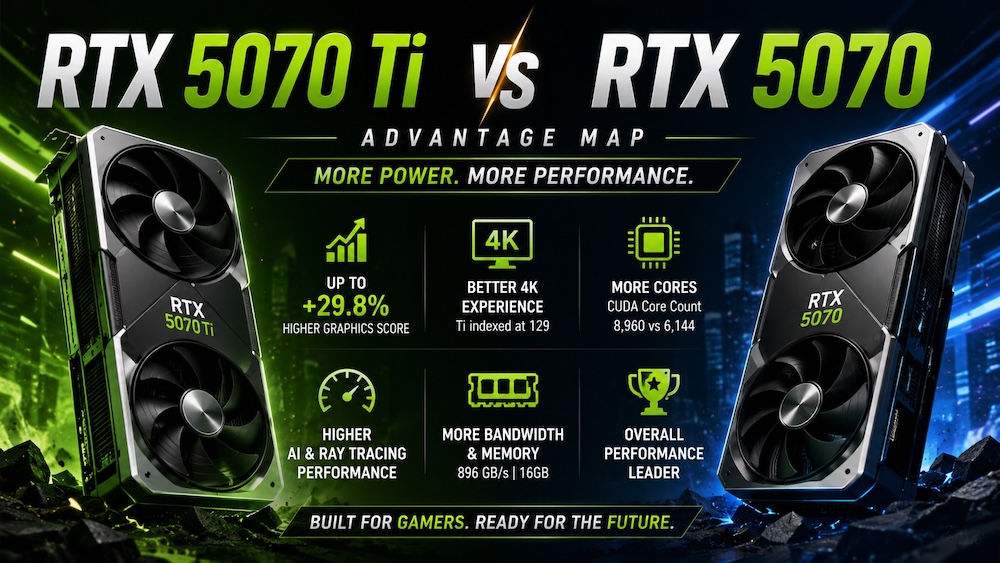
Nvidia RTX 5070 vs 5070 Ti specs comparison
The RTX 5070 Ti is not a small upgrade over the RTX 5070. It uses the same Blackwell generation and the same RTX 50-series software stack, but the hardware balance is different. The Ti card gets a larger core count, a wider memory bus, 16GB of VRAM, higher AI and ray tracing throughput, and an extra NVENC encoder. The regular RTX 5070 answers with a lower launch price, lower board power, and a smaller Founders Edition design.
| Spec point | RTX 5070 Ti | RTX 5070 | Why it matters |
|---|---|---|---|
| GPU generation | Blackwell | Blackwell | Both cards sit in the same Nvidia generation, so the feature list is broadly shared. |
| CUDA cores | 8,960 | 6,144 | The Ti has about 45.8% more CUDA cores, which is the biggest raw-hardware gap. |
| Boost clock | 2.45 GHz | 2.51 GHz | The RTX 5070 clocks a little higher on paper, but it has far fewer cores. |
| Base clock | 2.30 GHz | 2.33 GHz | The base clocks are close enough that they should not drive the buying decision. |
| Video memory | 16GB GDDR7 | 12GB GDDR7 | The Ti’s 16GB buffer is a major advantage for 4K, texture-heavy games, and creator work. |
| Memory bus | 256-bit | 192-bit | The Ti moves more data per cycle, which helps when resolution and texture pressure rise. |
| Memory bandwidth | 896 GB/s | 672 GB/s | The RTX 5070 Ti has one-third more bandwidth. |
| AI performance rating | 1,406 AI TOPS | 988 AI TOPS | The Ti has more headroom for DLSS-related hardware and local AI workloads. |
| Ray tracing rating | 133 TFLOPS | 94 TFLOPS | Ray tracing is one of the areas where the Ti’s larger chip should age better. |
| NVENC / NVDEC | 2x ninth-gen NVENC, 1x sixth-gen NVDEC | 1x ninth-gen NVENC, 1x sixth-gen NVDEC | The Ti is the stronger pick for heavier video-export and streaming workflows. |
| Total graphics power | 300W | 250W | The RTX 5070 uses 50W less board power. |
| Recommended system power | 750W | 650W | The non-Ti card is easier to pair with mainstream power supplies. |
| Reference card size | Varies by manufacturer | 242 mm, 2-slot Founders Edition | The RTX 5070 has a clearer compact-build story; many Ti partner cards are physically larger. |
| Launch MSRP | $749 | $549 | The Ti launched $200 higher, so its stronger performance still needs a sane street price. |
| Launch timing | February 20, 2025 | March 5, 2025 partner cards; Founders Edition later in March | The RTX 5070 Ti reached reviewers and buyers first. |
Comparative view chart
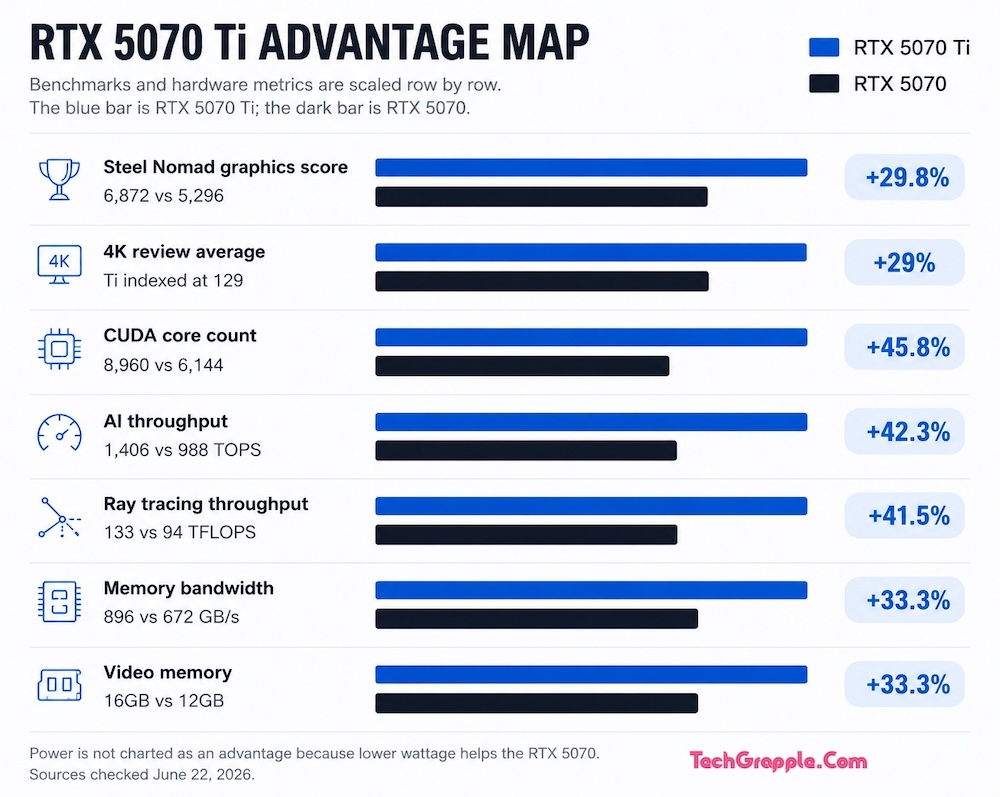
The chart below is a quick advantage map rather than a full benchmark database. Each row is scaled independently, so it is best read as: where does the RTX 5070 Ti open a meaningful lead, and where does the regular RTX 5070 stay close enough to remain sensible?
Benchmark scores and performance read
The cleanest measured split is around the 30% mark. PC Gamer’s Steel Nomad data lists an average score of 6,872 for the RTX 5070 Ti and 5,296 for the RTX 5070, which puts the Ti about 29.8% ahead in that modern raster benchmark. The Verge’s RTX 5070 review also reports that stepping up to the RTX 5070 Ti gives about 29% higher 4K frame rates in its test set.
These numbers are useful for direction, not as a universal FPS promise. Driver version, game patch, CPU choice, cooler design, factory overclock, graphics settings, DLSS mode, and the exact scene being tested can all move the result.
| Measured or rated item | RTX 5070 Ti | RTX 5070 | Gap | Plain-English read |
|---|---|---|---|---|
| 3DMark Steel Nomad average | 6,872 | 5,296 | +29.8% | The Ti has a clear lead in a modern graphics benchmark. |
| 4K gaming review average | 129 index | 100 index | +29% | At 4K, the Ti is meaningfully smoother before frame generation enters the discussion. |
| CUDA cores | 8,960 | 6,144 | +45.8% | The Ti has much more parallel shader hardware. |
| AI throughput rating | 1,406 AI TOPS | 988 AI TOPS | +42.3% | More Tensor-side capacity for AI-assisted rendering and supported creator apps. |
| Ray tracing throughput rating | 133 TFLOPS | 94 TFLOPS | +41.5% | Better headroom when RT effects are part of the game settings. |
| Memory bandwidth | 896 GB/s | 672 GB/s | +33.3% | The Ti has more room for high resolution and high-quality assets. |
| Graphics power | 300W | 250W | +50W on the Ti | This is the RTX 5070’s counterpoint: less heat, less power, easier builds. |
What this means for actual gaming
At 1440p, the RTX 5070 still makes sense. It has the same Blackwell feature family, supports DLSS 4, and has enough performance for many high-refresh gaming setups. If the monitor is 1440p and the goal is to stay closer to the $549 launch tier, the regular 5070 is not automatically the wrong answer.
The RTX 5070 Ti becomes easier to defend when the target is 4K, high texture settings, ray tracing, or a longer ownership cycle. Its lead is not only from the GPU core count; the 16GB memory configuration and 256-bit bus are practical upgrades. That extra memory will not make every current game faster, but it gives the Ti more breathing room when games start to spill past comfortable 12GB behavior.
There is also a difference in how confidently each card handles “turn everything up” settings. The RTX 5070 can be pushed into 4K with settings work and DLSS. The RTX 5070 Ti starts from a stronger base, which matters because upscaling and frame generation feel better when the native render path is already healthy.
DLSS 4 should not hide the raw gap
Both cards support DLSS 4, Multi Frame Generation, Ray Reconstruction, DLAA, and Reflex 2. That shared feature set is important because Nvidia’s software stack is part of the reason people buy RTX cards in the first place.
Still, generated frames do not erase the base-performance difference. Multi Frame Generation can raise the displayed frame count, but responsiveness is still tied to the frames the GPU actually renders. A card that is already stronger before frame generation usually gives the better final experience after frame generation is enabled.
That is why the RTX 5070 Ti is the safer pick for heavy ray tracing and 4K. The RTX 5070 can use the same tools, but it has less raw memory capacity, less bandwidth, and less rendering hardware behind those tools.
The 12GB vs 16GB question
The RTX 5070’s 12GB VRAM is enough for many 1440p games today, especially if you are willing to adjust texture quality when a title is unusually hungry. It is not a useless amount of memory. The issue is comfort margin.
The RTX 5070 Ti’s 16GB VRAM gives more room for 4K assets, ray tracing data, creator timelines, AI tools, and future game requirements. If you replace GPUs often, 12GB may be fine. If you keep a card for several years, the Ti’s memory configuration is the part of the spec sheet that may matter most.
Power, case fit, and partner-card reality
The RTX 5070 is easier to recommend for compact or moderate-power PCs. Nvidia lists 250W total graphics power and a 650W recommended system power. The Founders Edition is also a 242 mm, 2-slot card, which gives it a clear small-system advantage.
The RTX 5070 Ti moves to 300W and a 750W recommended system power. It is also partner-card only, so one RTX 5070 Ti can be much larger, louder, cooler, or more expensive than another. Before choosing the Ti, check the exact model length, slot thickness, connector clearance, and cooler reviews instead of assuming every Ti card behaves the same.
Price is the deciding variable
At launch pricing, the RTX 5070 Ti cost $749 and the RTX 5070 cost $549. That is a 36.4% higher price for the Ti. Against that, the strongest public comparison points used here show roughly a 29% to 30% performance advantage for the Ti in Steel Nomad and 4K review testing.
That does not make the Ti a bad buy. It means the exact checkout price matters. If the Ti is only moderately more expensive than the RTX 5070, its 16GB VRAM and stronger 4K performance are easy to justify. If it is priced far above MSRP or close to an RTX 5080, the value story weakens quickly.
Live prices have been unstable across RTX 50-series cards. Treat launch MSRP as historical context and check current listings before making a final call.
Buying recommendation
-
Best for 1440p value:
RTX 5070, as long as the price is meaningfully below the Ti and you are comfortable with 12GB VRAM. -
Best for 4K and ray tracing:
RTX 5070 Ti, because the larger chip, 16GB VRAM, and wider memory bus give it more headroom. -
Best for compact cases:
RTX 5070, especially the Founders Edition layout, because partner RTX 5070 Ti cards vary by size. -
Best for video export and creator work:
RTX 5070 Ti, mainly because it has more GPU hardware, more memory, and two ninth-gen NVENC encoders. -
Best if prices are inflated:
Compare both against AMD alternatives and the RTX 5080 before buying. The Ti is faster, but not at any price.
Final view
The RTX 5070 Ti is the stronger graphics card by a wide enough margin to feel like a real step up, not just a nameplate change. Its best argument is the combination of roughly 30% stronger 4K-oriented performance data, 16GB of VRAM, a 256-bit memory bus, and much higher RT/AI throughput ratings.
The RTX 5070 is the cleaner budget-and-build choice. It is lower power, easier to fit, cheaper at launch pricing, and still a capable 1440p GPU with the same RTX 50-series software features. The right pick depends less on which card is technically faster and more on your monitor, case, PSU, and the price gap on the day you buy.
FAQ: RTX 5070 vs RTX 5070 Ti
How much faster is the RTX 5070 Ti than the RTX 5070?
In the data used here, the RTX 5070 Ti is about 29.8% ahead in Steel Nomad average score and about 29% ahead in 4K gaming review testing.
Is the RTX 5070 good enough for 1440p?
Yes. The RTX 5070 is best understood as a strong 1440p card. It can also play at 4K with settings work and DLSS, but the RTX 5070 Ti is the more comfortable 4K option.
Does the RTX 5070 Ti have enough extra VRAM to matter?
Yes, especially for 4K, ray tracing, high texture packs, creator workloads, and longer-term ownership. The jump from 12GB to 16GB is one of the clearest reasons to buy the Ti.
Do both cards support DLSS 4 and Multi Frame Generation?
Yes. Both are RTX 50-series cards with DLSS 4 and Multi Frame Generation support. The Ti still has better raw hardware, so it usually gives a stronger starting point.
Which one should I buy if the price gap is small?
If the RTX 5070 Ti is only a modest step up in price, it is the better long-term card. If the gap is large, the RTX 5070 remains the better value for many 1440p builds.
Data note: Specs, launch details, benchmark context, and price-market context were checked on June 22, 2026. Retail prices can change by country, retailer, stock level, and partner-card model.