
Hybrid Cloud Solutions: The Best of Both Worlds
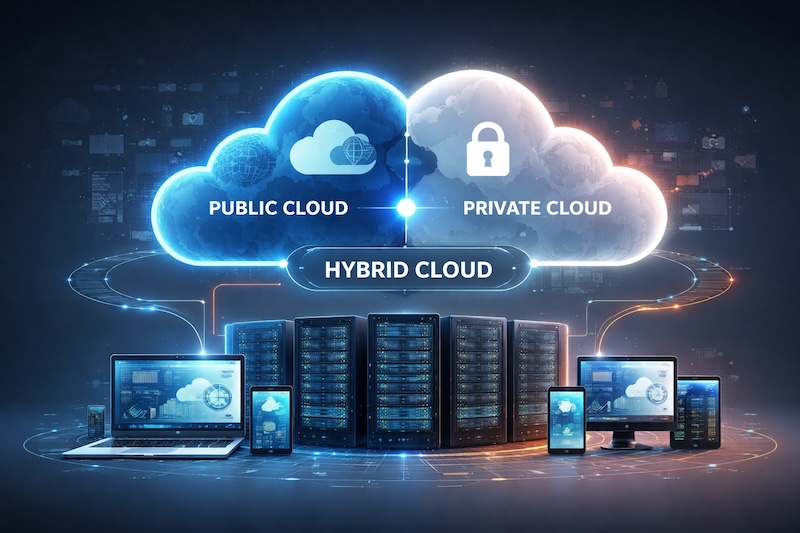
Think of it like having your own safe at home AND a bank account — you get the security of keeping things close AND the power of a bigger system. That’s exactly what hybrid cloud does for businesses.
Introduction
So, What Exactly Is a Hybrid Cloud?
Let’s start simple. You already know what a cloud is in real life — those fluffy things in the sky that store water. In the tech world, “the cloud” just means storing and running things on the internet instead of on your own computer.
Now there are two main types of cloud: a private cloud (your own, locked, personal space — like your home Wi-Fi) and a public cloud (a shared space — like a café’s Wi-Fi). Both are useful. But what if you could use BOTH at the same time, depending on what you need?
That’s what a hybrid cloud is. It’s a mix of your own private cloud and a big public cloud, connected together so data and apps can move back and forth between them. Businesses keep their sensitive, secret stuff on their private cloud and use the public cloud for everything else — like scaling up during busy seasons or testing new ideas.
Visual Explainer
How Does Hybrid Cloud Actually Work?
The three pieces of the puzzle work together like a well-oiled machine. Here’s how they connect:
🔗 The Hybrid Cloud Architecture
The hybrid layer is the smart middleman — it decides what goes where, keeps everything secure, and makes sure both clouds are talking to each other properly. Tools like Microsoft Azure Arc, Google Anthos, and AWS Outposts are popular choices businesses use to manage this connection.
When your business is having a slow day, most work happens on your private cloud. When things get crazy busy — like during a big sale or a product launch — extra computing power automatically kicks in from the public cloud. It’s like having a backup generator that only runs when the lights go out.
Market Data · 2025–2031
The Hybrid Cloud Market Is Exploding 🚀
This isn’t just a tech buzzword. The numbers show that businesses everywhere are betting big on hybrid cloud solutions — and for very good reasons. The global hybrid cloud market was worth $168.86 billion in 2025 and is expected to nearly double to $347.82 billion by 2031, growing at about 12–17% every year.
📊 Hybrid Cloud Market Growth (USD Billion)
Source: Mordor Intelligence, Precedence Research, 2026Industry Breakdown
Who’s Using Hybrid Cloud the Most?
From hospitals to banks to retail stores — hybrid cloud is being used across virtually every industry. Here’s a look at who’s leading the charge in 2025:
Industry Share of Hybrid Cloud Adoption
Source: Mordor Intelligence, 2025
Banks and financial institutions are the biggest fans of hybrid cloud — and honestly, it makes total sense. They need to keep customer account data super secure (private cloud) while using powerful AI tools to detect fraud in real time (public cloud). It’s like having a vault in the bank AND a security camera system in the cloud.
Why Businesses Love It
6 Big Benefits of Hybrid Cloud Solutions
Here’s why millions of businesses — from giant corporations to small shops — are switching to hybrid cloud:
You only pay for extra cloud power when you actually need it. No more buying expensive servers that sit around doing nothing 10 months of the year.
Private customer data, medical records, and financial info stays on your own secure servers. Only the less-sensitive stuff goes to the public cloud.
When your website gets a million visitors at once, public cloud resources kick in automatically. No crashes, no slowdowns, no panic.
Employees in London, Dubai, or Tokyo can all access what they need. Hybrid cloud powers remote work like a champ — as we all learned after 2020.
Different countries have different data laws. Hybrid cloud lets businesses store data exactly where laws require, avoiding massive fines and legal headaches.
AI and machine learning models need massive computing power. Hybrid cloud gives businesses access to that power without building their own supercomputers.
Side-by-Side Comparison
Private vs. Public vs. Hybrid Cloud — Which Wins?
Here’s an honest comparison so you can see why hybrid cloud often comes out on top for most businesses:
| Feature | 🏛️ Private Cloud | 🌐 Public Cloud | 🔗 Hybrid Cloud |
|---|---|---|---|
| Security | ✔ Very High | ~ Medium | ✔ High (customizable) |
| Cost | ✖ High upfront | ✔ Pay-as-you-go | ✔ Balanced & flexible |
| Scalability | ✖ Limited | ✔ Near-infinite | ✔ Best of both |
| Compliance | ✔ Full control | ~ Depends on provider | ✔ Fully configurable |
| Disaster Recovery | ~ Risky if local issue | ✔ Strong | ✔ Excellent dual-layer |
| Remote Work Support | ✖ Difficult | ✔ Great | ✔ Excellent |
| AI & Big Data Support | ✖ Limited compute | ✔ Strong | ✔ Optimal |
Real-World Stories
How Real Industries Use Hybrid Cloud Every Day
This isn’t just theory. Here’s how different industries actually use hybrid cloud right now, in plain English:
🏥 Hospitals & Healthcare
Patient medical records are super private — they stay on a secure private cloud. But AI tools that help doctors detect cancer in X-rays or predict patient risks? Those run on powerful public cloud servers. The result: faster diagnoses, better patient care, and full privacy compliance.
🏦 Banks & Finance
Banks keep your account history and transaction data on their own private servers (as the law requires). But their fraud detection AI — which checks millions of transactions per second — runs on the public cloud because it needs massive computing power. Banks are actually the #1 users of hybrid cloud, holding 35.9% of the market.
🛒 Retail & E-Commerce
Think about Black Friday. An online store that normally handles 10,000 visitors suddenly needs to handle 10 million. With hybrid cloud, the store automatically borrows public cloud power during the rush, then scales back down when it’s over. No crashes, no overspending on servers they only use one day a year.
🏭 Manufacturing
Factories use sensors to monitor machines for problems. The sensor data gets analyzed right there on the factory floor (edge computing on a private network) to catch issues instantly. But the long-term trend data — helping predict when a machine will need maintenance — gets sent to the public cloud for deeper analysis. Smart, right?
🏛️ Government
Governments love hybrid cloud too. Citizens’ personal data stays on government-controlled servers, but public-facing services — like applying for a passport online or checking your tax status — run on scalable public cloud platforms that can handle millions of requests without slowing down.
Regional Data · 2025
Where in the World Is Hybrid Cloud Growing Fastest?
North America leads the pack right now, but Asia-Pacific is catching up at an incredible pace:
🌍 Regional Market Share (2025) & Growth Rate
Source: Mordor Intelligence, 2026Asia-Pacific is the world’s fastest-growing region for hybrid cloud adoption. Countries like India, China, Japan, and Singapore are racing to digitise their economies. India’s government alone set a goal of 70% cloud adoption across government services by 2025, and China has pledged over $70 billion in cloud infrastructure investment.
Key Players
The Giants Behind Hybrid Cloud Solutions
These are the big names building the tools and platforms that power hybrid cloud for businesses worldwide:
☁️ Cloud Provider Market Share (Q3 2025)
Source: emma.ms Analysis, 2025Microsoft Azure is actually the top choice for hybrid cloud specifically, thanks to tools like Azure Arc and Azure Stack that make it easy to manage both private and public environments from one place. Azure’s deep connection with Microsoft 365, Teams, and Office also makes it a natural fit for businesses that already live in that ecosystem.
IBM made a strategic bet on hybrid cloud back in 2019 — buying Red Hat and doubling down on enterprise hybrid solutions. Other big players like Dell, Cisco, VMware, and HPE also offer important pieces of the hybrid cloud puzzle — think hardware, networking, and security tools.
Honest Talk
It’s Not All Sunshine — Here Are the Challenges
We’d be lying if we said hybrid cloud was perfect. Like any powerful tool, it comes with some real challenges businesses need to plan for:
The good news? All of these challenges have solutions. Modern hybrid cloud management platforms handle a lot of this automatically, and as the technology matures, it’s getting easier and cheaper every year.
Looking Ahead
What’s Next for Hybrid Cloud?
The future is looking very exciting. Here’s what’s coming down the pipeline:
NOW — 2026
AI Integration: Every major cloud provider is weaving AI directly into hybrid platforms. Tools that automatically decide where to run each workload — based on cost, speed, and compliance — are becoming standard.
2026–2028
Edge Computing Explosion: Over 75 billion IoT devices need real-time processing. Hybrid cloud will stretch from the data center all the way to the factory floor, the hospital room, and even your car.
2028–2030
Green Cloud: Businesses will use AI to automatically shift computing workloads to data centers powered by renewable energy — cutting carbon footprints without sacrificing performance.
2030+
Invisible Infrastructure: Hybrid cloud will become so seamlessly integrated that most employees won’t even know what’s running where. The complexity will all be handled automatically in the background.