
How Memory Games Can Help Kids: Play 5 Fun Memory Games
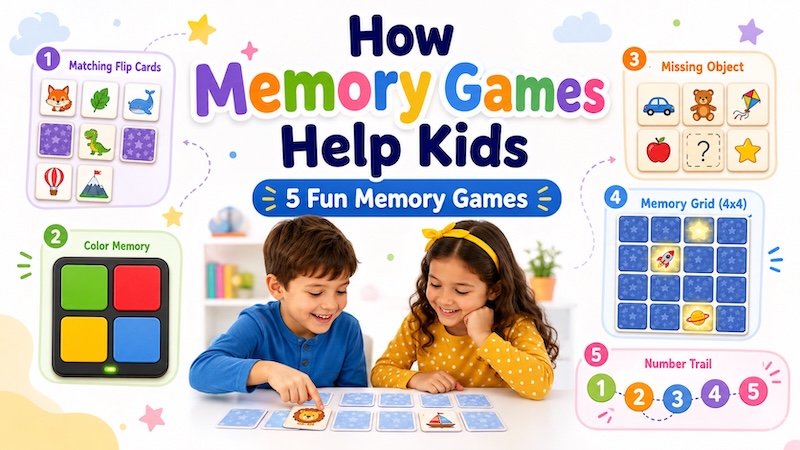
Memory games give kids a simple way to practice focus and recall. A child looks at a pattern, picture, sound, or number. The game then asks the child to remember what came before. That small challenge can train useful learning skills without turning practice into a worksheet.
The five memory games on this page use different types of recall. One uses picture pairs. Another uses color and sound. The other games work with missing objects, grid positions, and number locations. Kids can play them in short rounds and stop when attention starts to drop.
How Memory Games Can Help Kids
Memory games do more than ask kids to remember an answer. They also ask kids to notice details before the recall starts. That matters because strong memory begins with attention. A child cannot recall a card, sound, or location that was never noticed in the first place.
- Attention: Kids need to watch or listen long enough to collect the right information.
- Working memory: The brain holds a small amount of information while the child uses it.
- Visual recall: Picture and grid games ask kids to remember what they saw and where they saw it.
- Sequence memory: Color and number games ask kids to remember the correct order.
- Self-correction: A wrong choice gives quick feedback. The child can try again with a better plan.
1. Flip Card Match
Flip Card Match works on visual memory and location recall. Kids turn over two cards at a time. A matching pair stays open. A different pair flips back. The useful part comes from remembering where each picture appeared.
A child can start by looking for one picture at a time. Older kids can track several card locations at once. The move counter also gives a simple way to replay the game and see whether fewer turns are needed.
2. Color Beats
Color Beats adds sound and order to the challenge. The game plays a short sequence with four colored pads. Kids watch the lights and listen to the notes. Then they repeat the same pattern.
Each correct round adds one more step until the sequence reaches ten beats. Ten-beat rounds then continue for as long as the player answers correctly. The sound can be muted at any time without changing the game.
3. Missing Item
Missing Item gives kids three pictures to study at first. One picture disappears after three seconds. The child then chooses the missing picture from three options.
The game increases the number of items after a good streak, reaches five items, and then continues for as long as the player answers correctly. Kids practice noticing small visual details and holding a short picture list in mind.
4. Flash Matrix
Flash Matrix focuses on spatial memory. Several tiles glow inside a four-by-four grid. The glow lasts for a short time. Kids then tap the same positions after the color disappears.
The game starts with three glowing tiles and adds more as the child succeeds. Difficulty reaches ten glowing tiles, then ten-tile rounds continue until a wrong tap ends the run and shows the final score.
5. Number Trail
Number Trail combines number order with location memory. Numbers appear in different spots inside the play area for a short preview. They then hide automatically, and the child recalls each location in number order.
Kids continue by tapping the hidden spots in number order. Each completed round adds one more number up to ten, then ten-number rounds continue until a mistake ends the run and shows the final score.
How to Use Memory Games With Kids
Short sessions work well for most children. One or two rounds can give useful practice without turning the activity into a long task. The best level feels challenging but still gives the child a fair chance to succeed.
- Start with the easiest game or the smallest pattern.
- Let the child watch the full preview before giving hints.
- Ask the child to say a simple strategy after a round. A child may remember a corner, a color order, or one special picture.
- Use the restart button when the child wants a fresh round.
- Stop after repeated mistakes. A short break often works better than pushing through tired attention.
Which Memory Game Is Best for Different Kids?
Flip Card Match gives younger players an easy starting point because the goal stays clear. Missing Item also works well for kids who enjoy picture-based tasks. Color Beats suits children who like sound and rhythm. Flash Matrix adds a stronger location challenge. Number Trail works well for kids who already know number order and want a harder visual memory task.
There is no need to rush through all five games in one sitting. A child can repeat one favorite game and build confidence with that memory skill first.
Memory Games for Kids: Common Questions
Do memory games help kids concentrate?
They can give kids direct practice with focused attention. The child needs to watch or listen before making a choice.
What skills do matching games practice?
Matching games mainly use visual recall, attention, and location memory. Kids also practice checking whether two items are the same.
Are sequence memory games useful for kids?
Sequence games practice remembering order. That skill appears in everyday learning tasks such as following steps, copying patterns, and keeping track of number order.
Should a child keep playing after several wrong answers?
A short break can help when attention drops. The child can return later or restart at an easier level.