
What Is an AI Detector and Do You Really Need One? Accuracy, SEO, and School Use
Artificial intelligence can write articles, answer questions, create computer code, draw pictures, make videos, and help people study. This growth has also created a new type of tool called an AI detector.
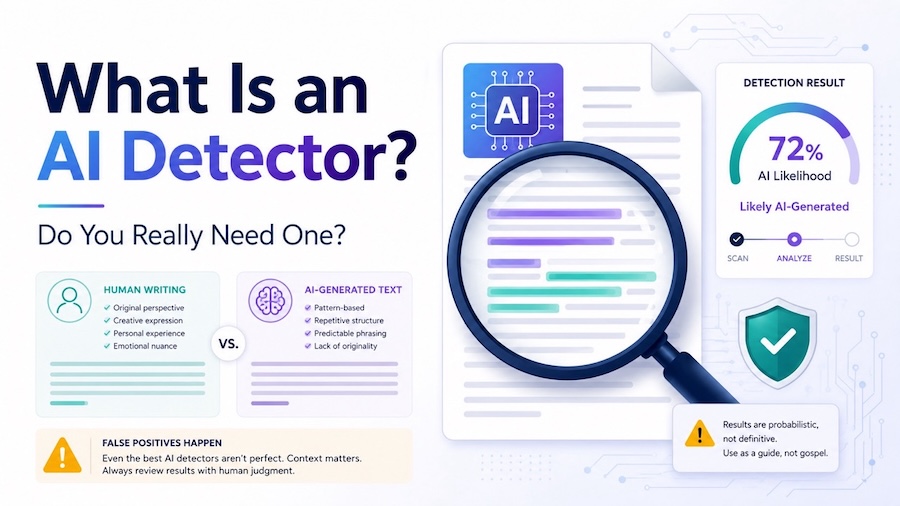
An AI detector claims to tell whether a person or an artificial intelligence tool created a piece of content. Some detectors check writing. Others check images, audio, videos, or computer code.
The idea sounds useful. A teacher may want to check a student’s assignment. A website owner may worry about Google rankings. A publisher may want to confirm that a writer completed the work. A reader may want to know whether a picture shows a real event.
The problem starts when people treat an AI detector score as proof. These tools do not see who created the content. They study patterns and make a guess. That guess can help with a wider review. It should not decide guilt on its own.
What Is an AI Detector?
An AI detector is a computer program that looks for signs often found in AI-generated content. A text detector checks word choice, sentence patterns, repetition, predictability, and writing rhythm. An image detector may check pixels, lighting, shapes, file information, and patterns left by an image generator.
The detector compares these signs with examples used during its training. It then gives a result such as:
- Likely written by a human
- Likely written by AI
- Mixed human and AI content
- Twenty percent AI-generated
- Ninety percent likely to contain AI writing
These labels look exact, but the number does not show how much of the article an AI tool wrote. A result such as “80 percent AI” often means the system has a high level of confidence in its own guess. It does not mean AI wrote exactly 80 percent of the words.
Different detectors also use different methods. The same paragraph can receive a low AI score from one service and a high score from another.
How AI Text Detectors Work
AI writing tools learn from large collections of text. They predict which word should come next. This often creates writing that sounds clear, balanced, and well organised.
AI detectors look for patterns linked with that type of prediction. A detector may check whether the next words are easy to predict. It may also look for sentences with similar lengths, repeated structures, common linking words, or a steady tone.
Some systems check how much the writing changes from one sentence to another. Human writing can include short sentences, unfinished thoughts, personal habits, small mistakes, sudden changes, and unusual word choices. AI-generated writing may look smoother.
These differences do not create a reliable rule. A skilled human writer may write clean and predictable sentences. A beginner may use simple words and repeat the same structure. A person who speaks English as a second language may also follow patterns that a detector connects with AI.
An AI tool can produce less predictable writing when the user gives it detailed instructions. A person can ask it to change sentence length, use simple words, add personal examples, remove common phrases, and avoid a polished tone. These changes can lower the AI score without changing who created the original text.

AI Detectors Can Mark Human Writing as AI
A false positive happens when a detector marks human work as AI-generated. This creates the biggest risk for students, writers, and employees.
A person may spend hours researching and writing an article. A detector may still give the article a high AI score. The score can rise because the writer uses clear grammar, a steady tone, simple sentence structures, or technical terms.
Technical writing creates a special problem. Medical, legal, scientific, and computer-related topics often require fixed terms. Writers cannot replace every exact term with a creative phrase. The subject itself makes the language more predictable.
Short passages can also produce unstable results. A detector has less information to study. A short answer may receive a high score because it contains common wording.
OpenAI once released its own AI text classifier. The company removed it on July 20, 2023 because of its low accuracy. During one test, it marked only 26 percent of AI-written text as likely AI-generated. It also marked 9 percent of human-written text as AI-generated. OpenAI stated that reliably detecting all AI-written text was impossible with that classifier. These figures describe one older tool. They do not measure every detector available today. They still show why a detector result needs careful review.
AI-Written Content Can Pass as Human Writing
AI detectors also make the opposite mistake. They can mark AI-generated work as human writing. This mistake is called a false negative.
A detailed prompt can change the writing style before the detector sees it. The user can ask for shorter sentences, small changes in rhythm, less common wording, personal examples, and a less polished tone.
A person may also edit the AI draft. Even a small amount of rewriting can change the patterns that a detector checks.
Research has shown that paraphrasing can weaken AI detection. One 2024 study found that small changes could cause a detection model to mark machine-generated text as human-written. The researchers also found that the model could face this problem within a short time. Another study examined repeated paraphrasing. It found that paraphrasing could lower detection rates while keeping much of the text quality. The researchers also described a deeper problem. Human and AI writing may become harder to separate as language models improve. This creates an uneven system. Careful human writing may receive an AI label. Edited AI writing may pass without a warning.
The AI Generator, Detector, and Humanizer Business Loop
The AI market has created an unusual business cycle.
First, companies gave people tools that could write content in seconds. These tools helped businesses produce articles, product descriptions, emails, lesson plans, computer code, and social media posts.
Next, another group of companies began selling AI detectors. Their message told users that AI-generated writing could create a problem. Schools, publishers, website owners, and companies started paying to find it.
The cycle did not stop there. AI humanizer tools appeared. These services use artificial intelligence to rewrite artificial intelligence content. Their goal is to make the text sound more human and pass AI detectors.
The full process now looks like this:

Researchers have studied tools that call themselves AI humanizers. One study reviewed 19 humanizer and paraphrasing services. It found that many existing detectors failed to identify the rewritten AI text. This does not mean every humanizer works. Some damage grammar, change facts, add strange words, or remove the writer’s meaning. The business model still creates a strange loop. One tool creates the content. A second tool raises fear about the content. A third tool rewrites it to satisfy the second tool.
A Fair Version of the Computer Virus Comparison
People sometimes compare this market with an old claim about antivirus companies. The claim says that antivirus companies create computer viruses and later sell software to remove them.
That claim should not be presented as a proven fact. There is no sound basis for saying that antivirus companies usually create viruses or pay people to create them.
The comparison can still explain the business loop in a different way. A new technology creates a problem. Another product offers protection from that problem. A third product appears to avoid the protection system.
AI writing tools created fast content. AI detectors then offered a way to identify that content. AI humanizers now promise to hide it. The same market profits from creation, fear, detection, and rewriting.
This does not prove that the companies secretly work together. It shows how one new technology can create several connected services.
AI Humanizers Do Not Make Weak Content Useful
An AI humanizer mainly changes writing style. It does not confirm that the facts are correct. It does not add real experience. It does not test a product. It does not interview an expert. It does not know what a business customer needs.
A humanizer may remove repeated phrases and change sentence patterns. It can also make a clear paragraph harder to read.
Website owners should not focus on passing a detector. They should focus on improving the content itself.
A useful editing process checks:
- Whether every important claim is correct
- Whether the article answers the reader’s main question
- Whether examples contain enough detail
- Whether the writer added original knowledge or experience
- Whether repeated sections can be removed
- Whether the title matches the actual content
- Whether the sources support the claims
- Whether the reader can understand each sentence
That work improves an article for readers. A lower detector score does not prove that the article has improved.
AI Image and Video Detectors Face Similar Problems
Modern image and video generators can create realistic faces, buildings, products, voices, and scenes. Older AI pictures often showed broken hands, strange teeth, unreadable text, or objects that merged together. Newer tools make fewer obvious mistakes.
A strange finger or shadow may raise concern. It cannot prove that an image came from AI. Human photographers can create strange lighting. Editing software can also produce visual mistakes. An AI-generated picture can look clean after careful prompting and editing.
Image detectors look for deeper patterns in pixels and file data. These systems may perform well on the image generators included in their training. They can struggle with a new generator that they have not studied.
Resizing, compression, filters, screenshots, and social media uploads can also change the file. Research on image detection has found that real-world changes and deliberate attacks can reduce detector performance. A stronger approach checks the history of the file. Content Credentials provide one method. They can record information about where a file came from and how someone changed it. The Coalition for Content Provenance and Authenticity created an open standard for this purpose. Content Credentials do not solve every case. A file may not contain them. Someone may remove file information. Still, a record of origin often provides better evidence than checking visual defects alone.
AI Content Does Not Automatically Harm SEO
Search engine optimisation means improving a website so search engines can understand it and show it to the right users.
Some website owners believe Google will lower the ranking of every article created with AI. Google’s published guidance does not support that belief.
Google says its systems focus on content quality instead of the method used to produce it. Useful AI-assisted content can rank. Human-written content can fail to rank when it offers little value.
Google also warns against using AI or other automated tools to create many pages without adding value. Mass-produced pages designed to manipulate search rankings may break Google’s spam rules. The correct answer needs one clear distinction:
Google recommends helpful and reliable content created for people. It asks site owners to provide original information, complete explanations, useful analysis, and added value instead of simply copying or rewriting other sources.
What Makes AI-Assisted Content More Useful?
AI can create a starting draft. A responsible publisher should then check and improve it.
Good AI-assisted content may include:
- Facts checked against trusted sources
- Original screenshots or photographs
- Real test results
- First-hand experience
- Clear examples
- Expert review
- Updated prices and dates
- Honest limits and warnings
- Answers to questions missed by competing pages
A website owner does not need an AI humanizer to achieve these goals. Careful editing and original work provide much more value.
Future Writers May Naturally Sound More Like AI
Children now use AI tools to study, explain ideas, improve grammar, and organise information. Many adults use them every day as well.
People often learn writing habits from what they read. A child who reads clear AI explanations may copy their sentence style. A worker who uses AI for emails may begin to follow the same structure without thinking about it.
This may make future human writing look more like today’s AI writing. At the same time, AI systems keep learning from human language. The two styles may move closer together.
This is a reasonable prediction rather than a fixed rule. People will still have personal voices, cultural styles, memories, opinions, and experiences. The overlap will make pattern-based detection harder.
A detector may then punish people for learning a clear and organised style. It may also favour writers who add mistakes only to look human. That result would not improve education or publishing.
Situations Where an AI Detector Can Help
AI detectors have limited uses. They can help find content that deserves a closer look. A company may scan thousands of fake reviews. A platform may search for large spam campaigns. A researcher may study patterns across a large collection of documents.
In these cases, the detector does not need to act as a judge. It can sort material and help a human reviewer decide what to check first.
A detector can also support a wider investigation when other evidence exists. That evidence may include missing drafts, copied facts, a sudden change in writing level, false citations, or an inability to explain the submitted work.
Situations Where an AI Detector Should Not Make the Decision
A detector should not make the final decision in cases that affect a person’s education, job, payment, or reputation.
Unsafe uses include:
- Failing a student based only on a detector percentage
- Refusing to pay a writer without reviewing the writing process
- Accusing an employee of dishonesty based on one scan
- Removing an article only because another detector gave a different result
- Calling a photograph fake without checking its source
| Situation | Detector score | Better evidence |
|---|---|---|
| Student essay | May provide a reason to review the work | Drafts, notes, classroom writing, source list, and an oral explanation |
| Freelance article | May show unusual writing patterns | Version history, research notes, fact checks, and agreed AI-use rules |
| Website SEO | Does not show whether Google will rank the page | Accuracy, originality, usefulness, reader response, and search performance |
| AI image | May identify known generator patterns | Original file, source history, Content Credentials, and supporting evidence |
| Computer code | Cannot prove who understood or designed the program | Live explanation, testing, debugging, version history, and code changes |
What Teachers Should Do About AI and Assignments
Teachers face a real problem. A student can ask an AI tool to write a long assignment within seconds. A detector cannot solve this problem on its own.
Schools need assessment methods that show understanding instead of only checking the finished document. UNESCO has also said that AI is forcing schools to reconsider traditional assessment. It recommends more focus on thinking, creativity, understanding, and responsible use.
Face-to-Face Discussions
A teacher can ask the student to explain the assignment in simple words. The discussion does not need to take long.
The teacher may ask:
- What is the main idea of your work?
- Which part was hardest?
- Where did you find this fact?
- Why did you choose this example?
- What would you change after receiving feedback?
A student who understands the topic should answer in a way that matches their age and ability. The student does not need to repeat the exact wording from the paper.
Use Supervised Classroom Writing
Teachers can ask students to write part of an assignment during class. This gives the teacher a sample of each student’s normal writing.
The school may already use classroom cameras under local rules. In that case, supervised writing can provide stronger evidence than an AI score. Schools must still follow privacy laws and inform families about recording policies. A teacher’s direct supervision often provides enough evidence without adding new surveillance.
Teachers can compare the supervised sample with the home assignment. A large difference does not prove cheating. It gives the teacher a reason to ask more questions.
Check the Work in Small Stages
A teacher can ask students to submit work in parts:
- The topic or question
- Research notes
- A simple outline
- The first draft
- Teacher feedback
- The improved version
This method shows how the student’s ideas developed. It also teaches planning and editing.
Set Clear Rules Before the Assignment
Students need to know which uses of AI the school allows.
A teacher may allow AI for:
- Explaining a difficult idea
- Finding possible topics
- Checking spelling
- Suggesting questions for research
- Giving feedback on an existing draft
The teacher may ban AI from:
- Writing the full final answer
- Inventing sources
- Completing a test
- Replacing the student’s own reading
- Creating work that the student cannot explain
A clear rule works better than trying to catch students after submission.
AI Use in Coding and Technology Projects
Schools should handle coding projects differently from basic writing tests.
Programmers already use tools that suggest code, find errors, explain functions, and build simple parts of an application. Preventing students from learning these tools may leave them unprepared for real work.
This does not mean that AI should replace the student’s skill. A student should understand what the code does. The student should also know how to test it, change it, find errors, and protect users.
A fair coding assessment can allow AI while checking the student’s own ability.
The student may need to:
- Explain the purpose of each important section
- Run the program in front of the teacher
- Change a feature during the review
- Find and repair a new error
- Explain why one method was chosen
- Show earlier versions of the project
- List the AI tools used
- Describe which ideas came from the student
AI can help a student create an app faster. The student’s talent still matters. The student must choose the problem, understand the user, judge the suggestions, test the result, improve the design, and take responsibility for mistakes.
Founders, employees, freelancers, teachers, researchers, and engineers can all create valuable work. Schools do not need to present business ownership as the only form of success. They should teach students how to build useful things and how to work with other people.
A Better Assessment Model for the AI Age

This model does not remove written assignments. It makes them part of a wider assessment.
A student may produce a strong paper with help from spelling tools, a parent, a tutor, or AI. The teacher can still check whether the student learned the subject.
The goal of education should not be to catch a machine-made sentence. The goal should be to develop knowledge, judgment, skill, honesty, and independent thinking.
Do Website Owners Need an AI Detector?
Most website owners do not need an AI detector for SEO.
A detector cannot tell whether Google will rank an article. It cannot confirm that the facts are correct. It cannot measure whether readers found the answer useful. It cannot replace editing.
A publisher may use a detector as one small part of a quality check. The publisher should first create a clear policy for writers. That policy may require writers to disclose AI use, check all facts, provide sources, and add original work.
Website owners should spend more time checking:
- Search intent
- Factual accuracy
- Original value
- Page speed
- Mobile usability
- Internal links
- Clear headings
- Outdated information
- Reader engagement
These checks affect the reader’s experience. An AI percentage does not.
Do Writers Need an AI Humanizer?
Writers usually do not need a humanizer. They need a good editing process.
A writer can improve an AI draft by checking every claim, removing repeated ideas, adding real examples, correcting the tone, and rewriting parts that sound empty.
A humanizer may help change sentence patterns. It may also add errors. Using one only to pass a detector encourages the wrong goal.
The goal should not be to make AI content look human. The goal should be to make the content accurate, useful, clear, and honest.
Do Teachers Need AI Detectors?
A school may use a detector as an early warning tool. Teachers need training before using it. Students should also know how the school handles detector results.
The school should have a clear review process. That process should include a discussion with the student, a look at earlier work, and a chance for the student to show understanding.
A detector result should never act as the only evidence.
Quick Answers About AI Detectors
Can an AI detector prove that AI wrote an article?
No. It can identify patterns and give a probability. It cannot watch the creation process or identify the real author with certainty.
Can human writing receive a high AI score?
Yes. Clear, simple, formal, technical, or predictable human writing may receive a high score.
Can AI content pass a detector?
Yes. Detailed prompting, human editing, paraphrasing, and humanizer tools can change the patterns that detectors check.
Does Google ban AI-written content?
No. Google focuses on quality and usefulness. It may take action against mass-produced content created to manipulate rankings or pages that add little value.
Should a teacher fail a student because of an AI score?
No. The teacher should review drafts, ask questions, check supervised work, and give the student a chance to explain the assignment.
Should students use AI for coding?
Schools can allow responsible use. Students should still understand the code, test it, explain it, change it, and fix errors.
Can AI image detectors identify every fake picture?
No. They can provide clues. New generators, file compression, screenshots, filters, and editing can affect the result.
The Practical Answer
AI detectors can help with large-scale screening and early review. They cannot reliably prove who created one specific piece of content.
Website owners do not need to chase a zero percent AI score. They need accurate and useful pages. Teachers do not need to replace judgment with software. They need better ways to check understanding. Publishers do not need to accuse writers based on one result. They need clear rules and evidence from the writing process.
AI generators, detectors, and humanizers will keep trying to defeat one another. A detector will improve. A rewriting tool will find a new way around it. The cycle may continue for years.
Treat an AI detector as a clue, not a verdict. Check the content, the evidence, the work process, and the person’s understanding before making a decision.