
Claude Opus 5 vs GPT-5.6 vs Kimi K3
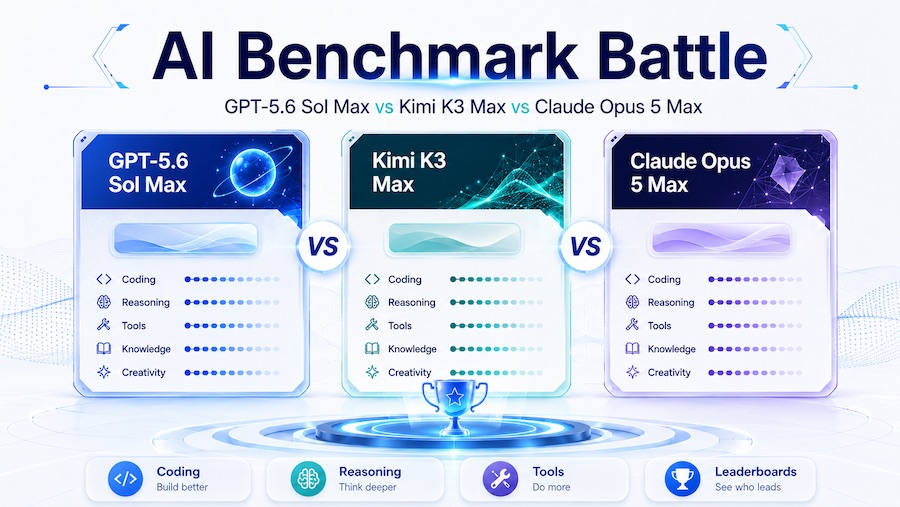
There is no honest way to declare one universal winner without first asking what kind of work it will do. A model that dominates a terminal benchmark may not produce the best-looking website. A model that writes polished reports may not be the fastest at fixing a broken repository. Cost, tools, reasoning effort and the agent framework surrounding the model also change the result.
One naming point is worth clearing up first: people searching for Kimi 3 usually mean Kimi K3, Moonshot AI’s 2.8-trillion-parameter flagship model. This Claude Opus 5 vs GPT-5.6 vs Kimi K3 comparison uses the Max setting for all three models. Anthropic released Claude Opus 5 on July 24, 2026, replacing Opus 4.8 as its strongest generally available Opus model.
Claude Opus 5 vs GPT-5.6 vs Kimi K3: Quick Verdict
| Category | Best model | Reason |
|---|---|---|
| Highest overall capability | GPT-5.6 Sol Ultra | Its multi-agent Ultra mode delivers the highest ceiling on difficult coding, research, browsing and tool-based tasks. |
| Best single-model visual coding | Kimi K3 Max | It is especially strong at combining code with screenshots, visual feedback, frontend design, games, CAD and interactive graphics. |
| Best careful coding collaborator | Claude Opus 5 Max | Opus 5 combines careful judgment with state-of-the-art results on Frontier-Bench, GDPval-AA v2 and several other agentic evaluations. |
| Best API value | Kimi K3 | Its standard API pricing is lower than both GPT-5.6 Sol and Claude Opus 5. |
| Best polished documents and presentations | GPT-5.6 Sol | It is highly capable at turning research and source files into structured documents, spreadsheets, diagrams and presentation-ready outputs. |
| Best long-form writing and editing | Claude Opus 5 | Its writing tends to feel deliberate, consistent and attentive to voice across long sessions. |
| Best option for open-weight deployment | Kimi K3 | Moonshot has announced full model weights, although this enormous model is not practical to run on an ordinary consumer computer. |
Overall winner: GPT-5.6 Sol Ultra, when cost and compute are secondary and the task genuinely benefits from parallel agents.
Most interesting practical alternative: Kimi K3 Max, particularly for developers creating games, visual interfaces, animated explanations, dashboards and other code-driven graphical projects.
Which Version of Each Model Is Being Compared?
The reasoning setting matters almost as much as the model name. Comparing GPT-5.6 Ultra against Claude at a low effort level would produce an impressive-looking table, but it would not be fair.
GPT-5.6 Sol Max
GPT-5.6 Sol is the strongest model in the GPT-5.6 family. This comparison uses Max, its highest single-agent effort setting, giving the model additional time to reason, test alternatives and revise its answer.
Ultra is different. It coordinates four agents in parallel by default rather than simply allowing one model to think for longer. This can improve results and reduce completion time on hard problems, but it also uses more tokens and compute. Ultra should therefore be treated as a premium multi-agent system, not a normal single-model reasoning mode.
Claude Opus 5 Max
Claude Opus 5 uses adaptive thinking and defaults to high effort in the Claude API and Claude Code. Users can increase this to extra, called xhigh, or to max for the most demanding work.
Claude’s higher effort levels are particularly useful for repository-wide changes, long asynchronous coding sessions and tasks that require the model to check its own decisions before acting.
Kimi K3 Max
Kimi K3 always uses a thinking process. Its API supports low, high and max reasoning effort, with max used for the strongest benchmark configuration.
K3 is also designed around agentic work. It can inspect visual output, modify code, run tools and continue iterating. This visual feedback loop is one of the main reasons it stands out for graphical programming.
GPT-5.6 vs Claude Opus 5 vs Kimi K3 Specifications
| Specification | GPT-5.6 Sol | Claude Opus 5 | Kimi K3 |
|---|---|---|---|
| Strongest mode discussed | Ultra multi-agent | Max effort | Max effort |
| Single-model high setting | Max | Max | Max |
| Context window | 1,050,000 tokens | 1 million tokens | 1,048,576 tokens |
| Maximum documented output | 128,000 tokens | 128,000 tokens | Depends on API and agent configuration |
| Standard API input price | $5 per million tokens | $5 per million tokens | $3 per million uncached tokens |
| Cached input price | $0.50 per million tokens | $0.50 per million cache hits | $0.30 per million cache-hit tokens |
| Standard API output price | $30 per million tokens | $25 per million tokens | $15 per million tokens |
| Vision input | Yes | Yes | Yes, natively multimodal |
| Model availability | Closed model | Closed model | Open-weight release announced |
| Best-known focus | Frontier reasoning, coding, tools and professional artifacts | Careful collaboration, enterprise work, writing and code review | Long-horizon coding, visual agents, interactive creation and value |
Kimi K3 is clearly the least expensive of the three at standard API rates. Its output tokens cost half as much as GPT-5.6 Sol output and considerably less than Claude Opus 5 output.
GPT-5.6’s long-context pricing can increase once a request passes the documented long-context threshold. Kimi advertises flat token pricing across its full context window, while Claude includes its one-million-token context at standard pricing.
Claude Opus 5 vs GPT-5.6 vs Kimi K3 Benchmark Results
The following results provide a useful snapshot, but they should not be read as a permanent league table. Agent harnesses, tool access, token limits, retry policies and benchmark versions can all move a score.
| Benchmark | GPT-5.6 Sol Max | Kimi K3 Max | Claude Opus 5 Max | Leader |
|---|---|---|---|---|
| DeepSWE v1.1 | 72.7 | 67.5 | 68.8 | GPT-5.6 |
| Terminal-Bench 2.1 | 89.5 | 85.0 | 89.1 | GPT-5.6 |
| FrontierBench v0.1 | 34.4 | Not reported | 43.3 | Claude Opus 5 |
| Program Bench | 77.6 | 77.8 | 82.3 | Claude Opus 5 |
| SWE Marathon | 39.0 | 42.0 | Not reported | Kimi K3 |
| GDPval-AA v2 Elo | 1,736 | 1,668 | 1,861 | Claude Opus 5 |
| AutomationBench | 29.7 | 30.8 | 26.0 | Kimi K3 |
| BrowseComp | 90.4 | 91.2 | 90.8 | Kimi K3 |
| SpreadsheetBench 2 | 32.4 | 34.8 | Not reported | Kimi K3 |
| CharXiv with tools | 89.1 | 91.3 | Not reported | Kimi K3 |
| ZeroBench with tools, Pass@5 | 35.0 | 41.0 | Not reported | Kimi K3 |
| ARC-AGI-3 | 7.8 | Not reported | 30.2 (high) | Claude Opus 5 |
The selected GPT configuration is GPT-5.6 Sol Max. GPT figures are based on OpenAI’s public GPT-5.6 benchmark appendix and the configuration-specific results noted in this comparison. Claude figures come from Anthropic’s Claude Opus 5 System Card, while Kimi figures come from Moonshot AI’s Kimi K3 comparison. “Not reported” means a vendor did not publish a result for that model and test. Harnesses and benchmark versions can differ, so small gaps should be treated cautiously.
Opus 5 changes the shape of the comparison. It now leads GDPval-AA v2 with an independently evaluated Elo of 1,861, moves much closer to GPT-5.6 on DeepSWE v1.1, and reaches 90.8 on BrowseComp. Anthropic also reports 43.3 on the newer FrontierBench v0.1, ahead of GPT-5.6 Sol at 34.4 and more than double Opus 4.8’s 21.1.
What Happens When GPT-5.6 Ultra Is Enabled?
The main comparison uses GPT-5.6 Sol Max as a single-model system. Separately, OpenAI reports that Ultra’s default four-agent setup raises its published one-agent baseline on Terminal-Bench 2.1 from 88.8 to 91.9 and BrowseComp from 90.4 to 92.2.
That moves GPT-5.6 ahead of Kimi K3 on both tests, but it does so by adding parallel agents. The result is impressive, though more expensive than asking one model to solve the task.
Why benchmark results vary
You may find a different score for the same model on another website. That does not automatically mean one result is false. Coding-agent benchmarks are affected by:
- The coding harness used around the model
- Maximum output-token limits
- Access to terminals, browsers and code execution
- Reasoning effort and number of attempts
- Context management and conversation compaction
- Safety filters that may stop part of a task
- Updates to the benchmark dataset or scoring method
A one-point difference should not decide a large purchase by itself. Wider gaps and repeated wins across several unrelated tests are more meaningful.
Which Model Is Best for Coding?
GPT-5.6: Best for Difficult End-to-End Engineering
GPT-5.6 Sol is the safest overall recommendation for highly complex engineering work. It performs strongly on repository tasks, terminal workflows, debugging, tool coordination and long sequences where the model must plan, act, inspect the result and try again.
Its biggest advantage is not merely writing a correct function. GPT-5.6 can behave like a technical operator: examine files, run commands, interpret errors, modify several components and validate whether the finished system actually works.
Ultra becomes useful when a task can be divided into parallel streams. For example, one agent can inspect the backend, another can review the frontend, a third can study test failures and a fourth can check deployment configuration. The system can then combine the findings.
GPT-5.6 is strongest for:
- Large production applications
- Difficult debugging and terminal tasks
- Multi-stage software engineering
- Tool-heavy autonomous agents
- Security analysis and defensive code review
- Projects requiring code, documents and visual artifacts together
Kimi K3: Best for Visual and Experimental Programming
Kimi K3 comes surprisingly close to GPT-5.6 on Terminal-Bench and beats it on several long-horizon, automation and program-generation tests in Moonshot’s evaluation.
Its most valuable advantage appears when coding is connected to something visual. K3 can inspect screenshots and use what it sees to change the code. That makes it a natural fit for web interfaces, browser games, 3D scenes, animations, CAD workflows, dashboards and scientific visualizations.
Instead of generating a page once and assuming it looks correct, a visual agent can render the page, inspect the result and continue fixing spacing, broken controls, camera angles, collisions or unreadable elements.
Kimi K3 is strongest for:
- Interactive websites and frontend development
- HTML, CSS, JavaScript and React experiences
- Browser-based 2D and 3D games
- Graphics, animation and motion design
- CAD and screenshot-guided development
- Scientific dashboards and interactive reports
- Developers who need strong performance at a lower API price
Claude Opus 5: Best for Judgment, Knowledge Work and Controlled Changes
Claude Opus 5 is no longer merely the cautious alternative. It leads the newer FrontierBench v0.1 terminal evaluation, GDPval-AA v2, SWE-bench Multilingual and AutomationBench among the models in Anthropic’s system-card comparison, while remaining close to GPT-5.6 on DeepSWE.
It is willing to challenge a weak approach, ask for missing information and point out that a requested change may damage another service. That behaviour is helpful in mature codebases where a confident but careless edit can create a costly problem.
Claude is particularly comfortable with long sessions involving architecture, documentation, code review and gradual refactoring. Opus 5 is also much stronger at verifying its work, working through visual feedback and completing difficult, open-ended tasks with less supervision.
Claude Opus 5 is strongest for:
- Code review and architectural discussion
- Repository exploration before implementation
- Refactoring where caution matters
- Explaining unfamiliar code clearly
- Maintaining style and intent across long sessions
- Enterprise workflows that require traceable judgment
Which Model Is Best for Visual Coding and Graphical Work?
Kimi K3 remains a compelling choice for code-driven visual creation, but Opus 5 is now a serious rival. This includes projects where the final result is not just text or source code, but something the user can see and interact with.
Examples include:
- A Three.js driving or stunt game
- An animated educational website
- A dashboard with interactive charts
- A WebGL product configurator
- A physics simulation
- A CAD-like editor
- A browser-based video or motion-graphics tool
Kimi K3 reached the top position on Arena’s WebDev leaderboard shortly after launch, although its score was still marked preliminary. It also ranked first on the React section of the same frontend coding evaluation.
The reason is not simply that K3 knows JavaScript. Its native multimodal design lets it combine instructions, source code and visual feedback. For a 3D game, it can inspect whether the car is floating above the road, whether a ramp connects correctly or whether mobile controls cover an important part of the screen.
Is Kimi K3 Always Better Than GPT-5.6 for Visuals?
No. The type of visual work matters.
Choose Kimi K3 when the visual itself is an interactive coded system: a game, website, simulation, 3D scene, animated diagram or design tool.
Choose GPT-5.6 when you need a polished business artifact: a presentation, formatted report, spreadsheet model, data visualization package or a project that combines research, writing and design.
Choose Claude Opus 5 when the project depends on careful visual iteration, editorial taste, narrative flow and maintaining a consistent creative direction across many revisions. Anthropic’s early-access reports highlight stronger animations, games, 3D work, presentations and responsive frontend checking than prior Opus models.
Reasoning, Research, Writing and Professional Work
GPT-5.6 for Research and Finished Deliverables
GPT-5.6 has a strong advantage when research must be converted into something usable. It can browse, analyse files, calculate figures, write code and assemble the result into a presentation, report, spreadsheet or working prototype.
Its GDPval-AA score also suggests strong performance on economically useful professional tasks. For consulting, finance, technical research and cross-functional projects, GPT-5.6 is the strongest all-round system of the three.
Claude Opus 5 for Writing, Knowledge Work and High-Stakes Review
Claude remains excellent at natural writing. Its strength is not flashy phrasing; it is the ability to hold a voice, recognise weak assumptions and produce dense but readable analysis.
Opus 5 substantially strengthens this case with a leading GDPval-AA v2 score of 1,861 and improved results in finance, legal work, due diligence, data analysis and long-horizon artifact creation. Anthropic’s automated behavioral audit also gave it a 2.3 score for overall misaligned behavior, the lowest among the recent Claude models it tested.
Kimi K3 for Research with Interactive Visualisation
Kimi K3 is particularly useful when research should become an explorable experience rather than a static answer. It can produce interactive timelines, charts, animated diagrams, dashboards and presentation-style visual narratives.
Its one-million-token context window also allows it to work with large document collections, codebases and research material. The lower API price makes repeated agent runs more practical for teams that need to process a large amount of information.
Weaknesses and Limitations
GPT-5.6 Weaknesses
- High output cost: GPT-5.6 Sol has the most expensive standard output tokens of the three.
- Ultra is not a simple model mode: It uses several agents, so its wins should not be presented as a free single-model improvement.
- Can be unnecessary for small tasks: A quick rewrite or simple function does not need frontier-level multi-agent reasoning.
- Closed platform: You cannot inspect or self-host the model weights.
- Long-context premium: Very large API requests can enter a higher pricing tier.
Claude Opus 5 Weaknesses
- Does not lead every coding test: GPT-5.6 still leads DeepSWE v1.1, while Kimi K3 narrowly leads the single-model BrowseComp figures in this comparison.
- Expensive output: At $25 per million output tokens, long max-effort sessions can become costly.
- Can overwork a task: Anthropic reports that higher effort sometimes causes Opus 5 to make more changes than a coding task requires, which hurt its FrontierCode score.
- Launch results need broader confirmation: Most Opus 5 figures are new and several were run by Anthropic, although GDPval-AA and ARC-AGI results were independently evaluated.
- Visual claims are still hard to compare: Early-access reports are strong, but there is not yet a controlled Opus 5 versus Kimi K3 visual-coding benchmark.
- Closed model: The weights are not available for local deployment.
Kimi K3 Weaknesses
- Vendor-reported results need independent confirmation: Many K3 figures come from Moonshot’s own launch evaluation.
- Can act too proactively: Moonshot warns that K3 may make unexpected decisions when instructions are ambiguous.
- Sensitive to thinking history: Performance can become unstable when an agent fails to preserve the model’s reasoning history or switches models during a session.
- User experience is not yet as polished: Moonshot acknowledges a noticeable experience gap compared with the strongest proprietary systems.
- Open weights do not mean easy local use: A 2.8-trillion-parameter mixture-of-experts model requires serious infrastructure. Moonshot recommends deployments with at least 64 accelerators.
- New leaderboard scores are preliminary: K3 needs more votes and long-term testing before its frontend ranking is considered fully settled.
Which AI Model Should You Choose?
Choose GPT-5.6 Sol Ultra When:
- You want the highest available performance regardless of cost
- The task is large enough to benefit from parallel agents
- You need research, coding, browsing and artifact creation in one workflow
- You are solving difficult engineering or professional problems
- You need a model that can stay active across a long chain of tools
Choose Claude Opus 5 Max When:
- You value thoughtful collaboration over raw benchmark leadership
- You need careful code review or architecture planning
- You are writing, editing or analysing sensitive professional material
- You want the model to challenge bad assumptions
- Your project involves a long codebase migration with strict controls
Choose Kimi K3 Max When:
- You are building visual websites, games, animations or 3D experiences
- You want the best performance-to-price ratio of these three models
- Your workflow uses screenshots or rendered output as feedback
- You need long-context coding and automation
- You want a future path toward open-weight deployment
- You are comfortable giving an agent clear boundaries and detailed instructions
A Practical Three-Model Workflow
For an important software project, the smartest approach may be to use the models together rather than forcing one model to do everything.
- Use Claude Opus 5 to examine requirements, challenge the architecture, identify risks and verify difficult changes.
- Use Kimi K3 to create and visually iterate on the frontend, interactive components or 3D experience.
- Use GPT-5.6 to integrate the complete system, debug difficult failures, run tools and validate the final result.
This workflow uses Claude’s judgment, Kimi’s visual coding ability and GPT-5.6’s end-to-end execution strength.
Final Verdict
GPT-5.6 Sol Ultra is the overall winner because it offers the highest performance ceiling and the most complete combination of reasoning, coding, research, computer use and professional artifact creation.
Kimi K3 Max is the standout for visual coding and value. It is the model I would test first for browser games, animated websites, 3D scenes, frontend interfaces, CAD workflows and interactive visualisations. Its benchmark results are close to GPT-5.6 in several areas, and its API costs significantly less.
Claude Opus 5 Max is the strongest single-model all-round challenger. It now tops several important coding and professional-work evaluations while retaining Claude’s strengths in review, judgment, writing and controlled long-session work.
The final ranking is therefore:
- GPT-5.6 Sol Ultra: best overall capability
- Claude Opus 5 Max: best single-model balance of coding, knowledge work, judgment and verification
- Kimi K3 Max: best value and a leading choice for visual coding
For most ordinary users, the most powerful option is not automatically the best purchase. The right winner is the model that completes your real task reliably without wasting time, tokens or money.
Frequently Asked Questions
Is Kimi K3 better than GPT-5.6?
Kimi K3 beats GPT-5.6 Sol Max on several automation, visual-agent and long-horizon coding benchmarks. Ultra moves ahead on key tests by adding parallel agents.
Is GPT-5.6 Ultra a fair comparison with Kimi K3 Max?
Not completely. Kimi K3 Max is one model using maximum reasoning, while GPT-5.6 Ultra coordinates four agents by default. This article therefore uses GPT-5.6 Sol Max for the main single-model comparison.
Which model is best for making 3D games and visual websites?
Kimi K3 is the strongest first choice for code-driven visual work because it can combine programming with screenshots and rendered visual feedback. GPT-5.6 is a close alternative and may be better for difficult integration and debugging.
Is Claude Opus 5 good for coding?
Yes. Claude Opus 5 leads the newer FrontierBench v0.1 evaluation and is particularly strong at repository exploration, root-cause analysis, code review, architecture, careful refactoring and long coding sessions. GPT-5.6 still leads DeepSWE v1.1 in the published comparison.
Which model is cheapest through the API?
Kimi K3 is the cheapest of the three at standard rates. Its uncached input price is $3 per million tokens and its output price is $15 per million tokens.
Can Kimi K3 run locally?
Kimi K3 is intended for an open-weight release, but its 2.8-trillion-parameter architecture is far too large for a normal desktop computer. Full-scale deployment requires enterprise-grade multi-accelerator infrastructure.
Which model has the largest context window?
All three support approximately one million tokens. GPT-5.6 Sol lists 1,050,000 tokens, Kimi K3 lists 1,048,576 tokens and Claude Opus 5 supports a one-million-token context window.