
Claude Text Watermark Explained: Why Users Are Upset and How OpenAI, Kimi K3 & DeepSeek V4 Compare
This article was written on August 11, 2026. Changes or new information after that date may not be reflected here.
Anthropic has announced a major change to Claude-generated text. New supported Claude models will place an invisible machine-readable watermark inside their text output. The watermark follows the text when someone copies and pastes it. Anthropic also says the signal may survive some editing.
Important note: Anthropic has confirmed what the watermark is intended to do, but it has not publicly disclosed the exact technical method used to create it.
The announcement caused an immediate backlash among some Claude users. Writers worry that edited work could still get tagged as Claude-processed. Developers have similar concerns about source code. Other users question whether changing the way a model selects words or tokens could affect output quality.
There is one important problem with many posts covering this story. They describe the technical system as if Anthropic has already explained it. Anthropic has not. The company has confirmed the behavior of the watermark but has not disclosed the exact method used to create it.
There is also no solid evidence of a mass Claude subscriber exodus. Social media contains angry posts and discussions about cancelling or switching models. That shows real backlash. It does not tell us how many paying customers have actually left.
The Short Answer
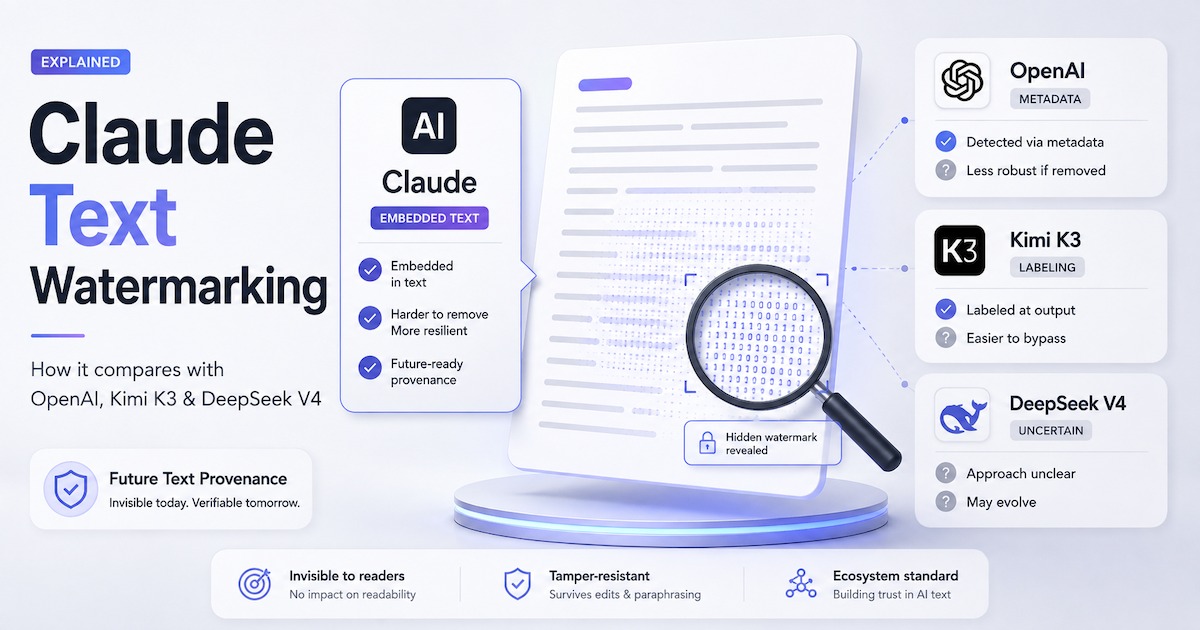
Claude: Yes. Anthropic has officially announced embedded text watermarks for supported Claude models. The watermark sits inside generated text rather than only inside a downloaded file. Anthropic says it survives copy-paste and may survive some editing.
ChatGPT and OpenAI models: OpenAI does not currently document an equivalent watermark inside normal ChatGPT text output. OpenAI uses machine-readable provenance technology for supported images and audio. The company says it plans to expand provenance support to text.
Kimi K3: Kimi’s hosted service already uses AI-generated-content identification. Moonshot AI says it adds visible identifiers and hidden identifiers. Its terms describe the hidden part as information embedded in file metadata. That is different from Anthropic’s disclosed copy-paste-resilient text watermark. I found no official Kimi K3 documentation describing an Anthropic-style watermark built into normal token generation.
DeepSeek V4: DeepSeek confirms that its hosted platform labels AI-generated material. Its developer terms also require developers to tell end users that DeepSeek API output comes from AI. I found no official DeepSeek V4 documentation describing a Claude-style watermark woven into the words or tokens of ordinary text.
The difference between AI labeling, metadata, and an embedded text watermark matters. These systems do not work in the same way.
What This Means for Users
Writers: Keep drafts, revision history, and notes that show how your work was created. A positive Claude signal may show that text was processed by Claude, but it cannot show how much of the original writing came from a person.
Developers: Treat generated or Claude-edited code as potentially identifiable text. If provenance matters, keep your commits and development history. Locally running an open model follows a different path from a hosted Claude service, but your own tools can still add labels or metadata.
Students and researchers: Check the rules of your school, publisher, or research organization before using AI assistance. Do not assume that a watermark detector can determine authorship or contribution by itself.
Businesses and reviewers: Do not use a positive watermark result as the sole reason to reject work, accuse someone of misconduct, or claim that Claude wrote an entire document. Human review and evidence of the editing process still matter.
What Anthropic Actually Announced About Claude Watermarking
Anthropic published its new guidance as part of its response to the European Union’s AI transparency rules. The company signed the EU AI Act Article 50 Code of Practice for AI-generated content.
According to Anthropic’s official Claude watermark documentation, Claude will use two separate methods.
- Generated text: an embedded and imperceptible text watermark.
- Supported files: digitally signed provenance metadata based on the Coalition for Content Provenance and Authenticity standard, commonly called C2PA.
The text watermark is the controversial part.
Anthropic says a supported Claude model will weave the watermark directly into generated text. A person reading the answer should not see it. Anthropic says the mark does not change the meaning, quality, or readability of the output.
The company also makes a stronger claim. The watermark should travel with the text during copy-paste and may remain detectable after some editing.
That makes it different from metadata attached to a document.
Diagram: Anthropic says its text watermark can follow copied text. C2PA provenance information belongs to a file and can disappear after some conversions, screenshots, or other processing.
Not Every Existing Claude Response Is Suddenly Watermarked
This detail has disappeared from many headlines.
Anthropic says Claude models launched on or after August 2, 2026 will support marking at launch. Models released before that date have a transition period. Anthropic says it is still adding support to those older models.
That means it is inaccurate to claim that every Claude answer from every model became watermarked on August 2.
Anthropic also says the system applies worldwide once a Claude model supports it. It is not limited to people living in the European Union.
The company lists Claude, Claude Code, Claude Platform API, Claude Cowork, Claude Tag, and supported cloud partners. Anthropic says the embedded text mark operates at the model level.
Why Some Claude Users Are Upset
The backlash is not hard to understand. Many people use Claude for far more than asking it to write an article from scratch.
A writer may paste a paragraph they wrote themselves and ask Claude to fix spelling. A developer may send original source code and ask Claude to find one bug. A researcher may ask it to reorganize notes. A translator may use it to translate human-written material.
Anthropic itself warns about this issue.
A detected Claude mark does not prove that Claude originally wrote the material. Anthropic says content processed through proofreading, translation, summarization, or file conversion may also carry a mark.
This point deserves more attention than the watermark itself.
Imagine that a person writes 1,500 words without AI. The person sends the article to Claude and asks for grammar fixes. The returned version could carry a Claude signal. A future detector might identify Claude processing even though the underlying ideas and most of the original writing came from a human.
The same concern applies to code.
A programmer could write an application, ask Claude to fix ten lines, and later have Claude-associated text inside the project. A watermark would show that Claude processed material. It would not tell an auditor how much Claude contributed.
This uncertainty explains much of the reaction in Claude communities. Some users have described the change as a reason to consider other tools. Others worry about employers, publishers, schools, code audits, or clients treating a positive signal as proof that AI created an entire piece of work.
Those concerns are worth discussing. Claims of a large-scale subscription collapse are not supported by public data at this point.
What Is an AI Text Watermark?
An AI watermark adds a detectable signal to generated content. The signal gives a detector extra information about where the material came from.
A text watermark is not the same thing as a normal AI detector.
A traditional AI detector looks at writing and tries to guess whether a model created it. It may examine sentence patterns, word predictability, structure, or other statistical features. The model that generated the text does not need to cooperate.
A watermark works differently. The generation system deliberately places a signal into the output. A matching detector then searches for that signal.
Several techniques can produce that result.
1. Statistical or Token-Level Watermarking
Large language models create text one token at a time. A token can represent a word, part of a word, punctuation mark, or another text fragment.
At each step, the model calculates probabilities for many possible next tokens.
A watermarking system can use a secret rule to give a tiny preference to certain acceptable tokens. The sentence can still sound normal. Across a long passage, those choices form a statistical pattern.
A detector with the correct method can test whether the pattern appears more often than chance would predict.
Conceptual example only: Statistical token watermarking works roughly like this. Anthropic has not confirmed that Claude uses this exact technique.
2. Invisible Unicode Characters
A much simpler method inserts characters that a person cannot normally see. Examples include zero-width spaces and other Unicode formatting characters.
The hidden characters can encode information inside what appears to be ordinary text.
This technique has a major weakness. Text normalization, sanitization, or software that removes hidden characters can destroy the signal.
3. File Metadata
A service can attach information to a file instead of changing the visible content.
An image, document, or another file may contain metadata saying which software created it. Cryptographic signatures can make that metadata harder to forge.
This approach works well for provenance. It behaves differently from a text watermark because copying plain text out of a file normally does not copy the entire file metadata structure.
4. Visible AI Labels
The simplest method tells the user directly that content came from AI.
A website might display “AI-generated” beside an answer. An image could contain a visible watermark. A platform could show a banner.
Visible labels improve transparency but do not create the same persistent signal as an embedded text watermark.
How Can a Watermark Hide Inside Normal-Looking Text?
This part causes the most confusion.
A watermark does not need to spell a secret message using hidden characters.
Consider a language model choosing between these sentences:
- The system uses less memory.
- The system requires less memory.
- The system consumes less memory.
All three could fit the same context.
A statistical watermark could use a hidden rule that slightly prefers one acceptable choice. The rule repeats across hundreds of token decisions.
No single word proves anything. The pattern across a large sample creates the signal.
This also explains why short text can become difficult to detect. Anthropic specifically says a short passage may not contain enough information for a reliable watermark signal.
Heavy editing can cause the opposite problem. Rewriting enough words destroys part of the statistical pattern. Anthropic says heavily edited, paraphrased, translated, or mixed content may lose a detectable mark.
Is Claude’s New Watermark Just Hidden Unicode Characters?
There is no evidence from Anthropic that confirms this.
Many social-media posts jumped from “invisible watermark” to “zero-width Unicode characters.” That is speculation.
Anthropic says the watermark is woven into text, operates at the model level, survives copy-paste, and may survive some editing. The company has not published the technical recipe.
Anthropic also says it will release more documentation about detection later.
A statistical token watermark would fit several parts of Anthropic’s description. Other techniques could fit too. Until Anthropic publishes the technical details, calling the Claude system a specific token watermark or Unicode watermark goes beyond the available evidence.
This distinction matters because the removal and detection properties differ a lot between techniques.
Claude vs OpenAI vs Kimi K3 vs DeepSeek V4 Watermarking
| AI service | Text identification confirmed? | Claude-style embedded text watermark confirmed? | What the company actually documents |
|---|---|---|---|
| Anthropic Claude | Yes | Yes, for supported models | Invisible watermark embedded directly in generated text. Anthropic says it follows copy-paste and may survive some edits. Older models are still being updated. |
| OpenAI / ChatGPT | Not currently documented for normal text output | No current public deployment documented | OpenAI currently documents provenance signals for supported images and audio. It says expanding provenance to text is a goal. |
| Kimi / Kimi K3 hosted service | Yes | Not publicly documented | Kimi says it adds visible AI labels and implicit identifiers. Its terms define the hidden identifier as a technical marker in file metadata. |
| Kimi K3 run locally | Depends on the software running it | No mandatory system publicly documented | The hosted Kimi identification layer is separate from running the open model with your own inference stack. |
| DeepSeek hosted service | Yes | Not publicly documented | DeepSeek says it adds AI-generated-content identifiers on its platform under Chinese rules. |
| DeepSeek V4 via API | Developer disclosure required | No Claude-style mechanism publicly documented | DeepSeek’s API terms require downstream developers to clearly disclose that output is AI-generated. |
| DeepSeek V4 run locally | Depends on your inference application | No mandatory provider watermark publicly documented | A local inference stack does not use DeepSeek’s hosted interface or its platform-level labeling layer unless the developer adds one. |
Important: “Not publicly documented” does not mean a company could never use another internal provenance technique. It means I found no official documentation showing the same type of embedded, copy-paste-resilient text watermark that Anthropic has now announced.
Does ChatGPT or OpenAI Watermark Text?
As of August 11, 2026, OpenAI’s current provenance documentation does not list ordinary ChatGPT text as a supported provenance format.
OpenAI currently documents provenance signals for supported images and audio. Its verification system can check supported files for signals such as SynthID or C2PA information.
The company’s help page has a separate question about text output. OpenAI says its goal is to expand provenance signals to all modalities, including text.
That wording matters. OpenAI describes text as a direction it plans to support. It does not describe a Claude-style text watermark as already active across normal ChatGPT answers.
OpenAI Has Researched Text Watermarks Before
This does not mean OpenAI has ignored text watermarking.
In 2024, OpenAI publicly discussed a text watermarking method it had developed.
OpenAI said the technique showed strong accuracy in its tests and could withstand some local changes. The company also identified weaknesses.
Large-scale rewriting or translation could damage the signal. OpenAI also raised fairness concerns. It noted that watermark-based judgments could create problems for groups such as people who use AI as a writing aid because English is not their first language.
Those concerns sound more relevant now because Anthropic’s own documentation makes clear that proofreading and translation can produce Claude-marked output.
OpenAI Has Signed the Same EU Transparency Code
OpenAI appears beside Anthropic on the European Commission’s Section 1 list of signatories.
That means OpenAI is also working under the new AI-generated-content transparency framework. It does not mean OpenAI must copy Anthropic’s exact technical method.
Different companies can use different technical solutions as long as their approach meets the applicable requirements.
Does Kimi K3 Watermark Text?
Kimi requires a more careful answer because the hosted Kimi service and the Kimi K3 model are not the same thing.
Moonshot AI’s current Kimi terms contain an entire section called “AI-Generated Content Identification Rules.”
The terms cover text, images, audio, and video.
Kimi defines two types of identifiers.
- Explicit identifier: something users can see or hear. This can include an AI-generated label, visible watermark, or page banner.
- Implicit identifier: a technical marker embedded in file metadata for traceability.
Kimi says it adds both types by default to generated content unless an approved function allows removal of the explicit identifier.
That sounds similar to Anthropic at first. The implementation described in the terms is different.
Moonshot explicitly defines its implicit identifier as a marker in file metadata. Anthropic describes its text mark as part of the text itself and says it travels through copy-paste.
I found no official Kimi K3 documentation saying normal Kimi K3 text contains a statistical or model-level watermark that survives copying into a plain text editor.
What About the Open Kimi K3 Model?
Kimi K3 can also exist outside kimi.com through its published model ecosystem.
When someone runs Kimi K3 locally, the request does not pass through the normal Kimi website. Moonshot’s website cannot attach its interface banner to that local response.
The local program can still add labels or provenance data. A developer could also build a watermark system around Kimi K3.
I found no mandatory Anthropic-style text watermark disclosed in the official Kimi K3 repository documentation.
This is an important advantage of separating the model from the hosted product when comparing AI provenance systems.
Does DeepSeek V4 Watermark Text?
DeepSeek also uses AI-content identification, but its public documentation does not describe the same system Anthropic just announced.
DeepSeek’s current terms say the company has added identifiers to AI-generated content inside its platform to comply with China’s AI-generated-content identification rules and national standards.
Users are told not to remove, alter, hide, forge, or bypass those identifiers.
That confirms labeling.
It does not confirm an invisible statistical watermark woven into every DeepSeek V4 sentence.
I found no statement in DeepSeek’s public V4 material saying that copied V4 text carries a hidden model-level fingerprint that survives editing.
DeepSeek API Works Differently
DeepSeek’s Open Platform terms place an important obligation on API developers.
Developers who build products around DeepSeek must clearly tell their end users that the output comes from AI.
This again shows the difference between a disclosure rule and an invisible watermark.
A website can label a DeepSeek response as AI-generated without changing the words inside the response.
What About DeepSeek V4 Flash and Local V4?
DeepSeek has published V4 model material, including DeepSeek V4 Flash.
Running open model weights through your own local software removes the hosted DeepSeek interface from the generation path.
I found no official V4 documentation that describes a mandatory Claude-style embedded text watermark.
A local inference program could still add its own watermark. The model operator controls that layer.
Why Hosted AI and Local Open Models Need Separate Comparisons
This difference can completely change the watermark question.
Think of an AI service as several layers:
- The model weights.
- The inference engine that generates tokens.
- The provider’s server.
- The chat interface.
- The export or file-generation system.
A visible “AI-generated” banner can live in layer four.
File metadata can be added in layer five.
A statistical token watermark can operate during layer two.
When you download open weights and run them on your own computer, layers three through five belong to you instead of the original AI provider.
This is why saying “Kimi has watermarks” or “DeepSeek has no watermarks” without specifying the hosted service, API, or locally run model creates a misleading comparison.
Could Anthropic’s Watermark Affect Claude’s Writing or Coding Quality?
This is one of the biggest unanswered questions.
Anthropic says its watermark does not change the meaning, quality, or readability of Claude output.
We do not yet have enough technical information to independently judge that claim.
If Anthropic uses statistical token watermarking, the generation system would normally alter token-selection probabilities in some way. That does not automatically mean quality becomes worse.
A language model often has several good choices for the next token. A small preference among similar choices could create a detectable statistical signal without producing an obvious difference to a reader.
Code makes the issue more interesting.
Natural language often allows many equivalent phrases. Source code can have fewer safe alternatives at a specific location. The effect depends heavily on how the watermark operates and when the system allows the original highest-probability token to win.
Anthropic has not released benchmarks showing watermark-on versus watermark-off performance for coding, reasoning, creative writing, or long-form text.
Claims that the watermark definitely destroys coding quality therefore go beyond the evidence. Claims that it has absolutely zero measurable effect also need independent testing once the technical system becomes available.
Does Claude Watermark Code Too?
Anthropic says embedded watermarks will apply to all generated text from supported models.
Code returned as text therefore appears to fall under that description.
There is one practical limit. Anthropic says very short passages may not contain enough text for reliable detection.
A five-line function may not provide the same signal strength as a 2,000-word article. A large source file or a long coding session could provide more material for a statistical detector.
We will know more after Anthropic releases its promised detection and technical documentation.
What Happens When Claude Only Proofreads Human Writing?
This may become the most controversial real-world case.
Anthropic says a detected watermark signals that content may have been processed by Claude. It does not prove Claude created the original material.
That means a watermark detector cannot safely answer questions such as:
- Who wrote the original article?
- How much of the text came from Claude?
- Did Claude only correct spelling?
- Did Claude rewrite every paragraph?
- Did a human heavily edit the final version?
- Who owns the ideas?
A positive signal answers a narrower question. It suggests supported Claude processing occurred somewhere in the content’s history.
Schools, employers, publishers, and software auditors will need to understand this limitation. Treating a positive mark as proof of full AI authorship would go beyond what Anthropic itself says the mark proves.
Can You Detect Claude’s Invisible Watermark Yourself?
Not reliably yet.
Anthropic says it plans to provide detection support and more technical documentation. That documentation was not publicly available when this article was researched on August 11, 2026.
You can check text for invisible Unicode characters. That test can expose one simple kind of hidden marking. It cannot tell you whether Anthropic’s new watermark is present.
This JavaScript example checks several common invisible Unicode characters:
const text = `Paste text here`;

const invisibleChars = /[\u200B\u200C\u200D\u2060\uFEFF]/g;
const matches = [...text.matchAll(invisibleChars)];

if (matches.length === 0) {
    console.log("No tested invisible Unicode characters found.");
} else {
    console.table(
        matches.map(match => ({
            index: match.index,
            character: "U+" +
                match[0].codePointAt(0)
                    .toString(16)
                    .toUpperCase()
                    .padStart(4, "0")
        }))
    );
}
Do not misread the result. Finding zero-width characters does not prove that Claude inserted them. Many editors and websites use invisible Unicode for legitimate reasons.
Finding none also does not prove that a Claude watermark is absent. A statistical watermark would not require unusual Unicode characters at all.
Why a Normal AI Detector Is Not Enough
Sites that claim to detect AI writing usually analyze linguistic patterns. They do not possess Anthropic’s private watermark detection system unless Anthropic has specifically provided it.
An AI detector score and a verified Claude watermark result are therefore two different things.
One is a prediction.
The other searches for a signal deliberately inserted by the generating system.
Why Is Anthropic Adding Text Watermarks Now?
The timing comes from the European Union’s AI Act transparency requirements.
The Article 50 transparency obligations became applicable on August 2, 2026.
The European Commission’s Code of Practice on Transparency of AI-Generated Content describes machine-readable marking for generated text, images, audio, and video.
The goal is to make artificially generated or manipulated material detectable where technically feasible.
The code itself provides a voluntary route for demonstrating compliance. The underlying Article 50 transparency requirements are legal obligations.
About 190 organizations had signed the code by the end of July 2026.
The European Commission’s published Section 1 list includes Anthropic and OpenAI. It also includes companies such as Google, Meta, Microsoft, Mistral, Cohere, and others.
Moonshot AI and DeepSeek were not listed among the Section 1 signatories on the Commission page last updated August 5, 2026.
That does not prove those companies ignore AI-labeling requirements. A company can operate under different legal regimes or demonstrate compliance through another route. Kimi and DeepSeek already document AI-content identification requirements connected to Chinese regulation.
China Already Has AI-Generated Content Identification Rules
This is another reason the Kimi and DeepSeek comparison needs context.
China’s Measures for the Identification of Artificial Intelligence-Generated Synthetic Content took effect in September 2025.
The framework covers generated text, images, audio, video, and other synthetic material. It distinguishes visible identification from less visible technical identification.
Kimi’s current terms closely reflect that structure. Moonshot says it uses explicit identifiers and implicit metadata identifiers.
DeepSeek also says it has added generated-content identifiers to its platform under those rules and related national standards.
China’s system should not automatically be described as the same type of text watermark Anthropic is introducing. “AI content identification” covers several technical methods.
What Anthropic’s Watermark Does Not Prove
This part is worth saving because watermark detection will likely get misused.
A detected Claude watermark does not prove:
- Claude wrote the whole document.
- The content is false.
- The content is accurate.
- A specific person generated it.
- The person did not write an earlier human version.
- The material has not changed since Claude processed it.
- Claude owns the text.
- The detected section represents the rest of the document.
Anthropic itself says the signal indicates that material may have been processed by Claude.
That wording is much narrower than “Claude wrote this.”
Can Claude’s Watermark Survive Editing?
Anthropic says it may survive some editing.
The company also lists situations where detection can fail.
- Heavy editing.
- Paraphrasing.
- Translation.
- Mixing Claude text with other writing.
- Very short passages.
- Output from a model that does not yet support marking.
This tells us something important about the design even though Anthropic has not disclosed the algorithm.
The watermark is not an indestructible serial number.
Detection relies on enough of the relevant signal remaining in the final content.
Is a Text Watermark the Same as C2PA?
No.
Anthropic is using both systems for different purposes.
C2PA stands for the Coalition for Content Provenance and Authenticity. It provides a standard for recording signed provenance information about digital files.
Claude can attach C2PA-style signed information to supported formats such as SVG, PNG, and JPEG files.
The embedded text watermark works differently. Anthropic says that signal sits in the text itself.
This difference explains why normal copy-paste can preserve the text watermark while leaving file metadata behind.
Frequently Asked Questions About Claude Text Watermarking
Is Claude watermarking every response right now?
No. Anthropic says models launched on or after August 2, 2026 support marking at launch. The company is still adding marking support to models released before that date.
Is the Claude watermark visible?
No. Anthropic describes the text watermark as imperceptible. It should not appear as a visible label inside normal generated text.
Does the Claude watermark survive copy and paste?
Anthropic says yes. The company says the watermark travels with the text when copied and pasted elsewhere.
Can editing remove the Claude watermark?
Detection can fail after enough modification. Anthropic specifically lists heavy editing, paraphrasing, translation, mixing with other material, and very short text as situations that can weaken or remove a detectable signal.
Does Claude use invisible Unicode characters?
Anthropic has not said that. Claims that the new watermark consists of zero-width Unicode characters are speculation unless Anthropic releases technical information confirming it.
Is Claude using statistical token watermarking?
Possibly, but that has not been confirmed. Statistical token watermarking fits several properties Anthropic describes, including model-level generation and survival through normal copy-paste. Anthropic has not disclosed the exact implementation.
Does ChatGPT put an invisible watermark in normal text?
OpenAI’s current provenance documentation does not say that normal ChatGPT text output contains such a watermark. OpenAI currently documents supported image and audio provenance and says text support is a future goal.
Has OpenAI researched text watermarking?
Yes. OpenAI publicly discussed a text watermarking method in 2024. It also discussed weaknesses involving large-scale rewriting, translation, circumvention, and possible fairness concerns.
Does Kimi K3 use watermarks?
The hosted Kimi service uses AI-content identifiers. Moonshot describes visible identifiers plus hidden technical markers in file metadata. I found no official documentation confirming an Anthropic-style watermark embedded into ordinary Kimi K3 text generation.
Does DeepSeek V4 watermark its text?
DeepSeek confirms generated-content labeling on its hosted platform. I found no official V4 documentation confirming the same copy-paste-resilient text watermark described by Anthropic.
Will locally running Kimi K3 or DeepSeek V4 add the same hosted labels?
Not automatically through the provider’s website because local inference does not use that hosted layer. Your inference program or another application can still add its own labels, metadata, or watermarking system.
Does a Claude watermark prove Claude wrote the content?
No. Anthropic explicitly warns that proofreading, translation, summarization, and other processing can create marked output even when the original material came from a human or another source.
My Take After Comparing the Actual Documentation
Anthropic has gone further than OpenAI, Kimi, and DeepSeek in publicly describing a persistent watermark inside ordinary generated text.
The most unusual part is not simply that Claude output receives an AI label. Other companies already use provenance and AI-content identification.
The major change is Anthropic’s claim that the signal lives inside the text, operates at the model level, travels through copy-paste, and can survive some editing.
OpenAI has researched this type of technology but does not currently document it as active for normal ChatGPT text. Kimi’s hosted service uses both visible and hidden identification, but its terms describe the hidden layer as file metadata. DeepSeek confirms platform-level generation identifiers without publicly describing an equivalent V4 text fingerprint.
The open-model comparison also matters. A locally run Kimi K3 or DeepSeek V4 setup does not automatically pass output through the companies’ hosted labeling interfaces. That gives local deployments a different provenance path.
The biggest unanswered question remains technical. Anthropic has not explained exactly how its text watermark works. It has not released the public detector yet. It has not shown independent quality comparisons for coding, writing, and reasoning with the watermark enabled.
Until those details arrive, two extreme claims should be avoided. It is too early to say the watermark definitely harms Claude’s output. It is also too early to treat every marked passage as proof that Claude authored the work.
What we can say with confidence is simpler: AI text provenance has moved from research into real commercial language-model output. Claude is one of the clearest examples so far. OpenAI has already said text provenance is part of its future direction. This issue will not end with Anthropic.