
Intel Core Ultra 7 270K Plus vs AMD Ryzen 9 9950X3D2 Dual Edition: Specs and Benchmarks
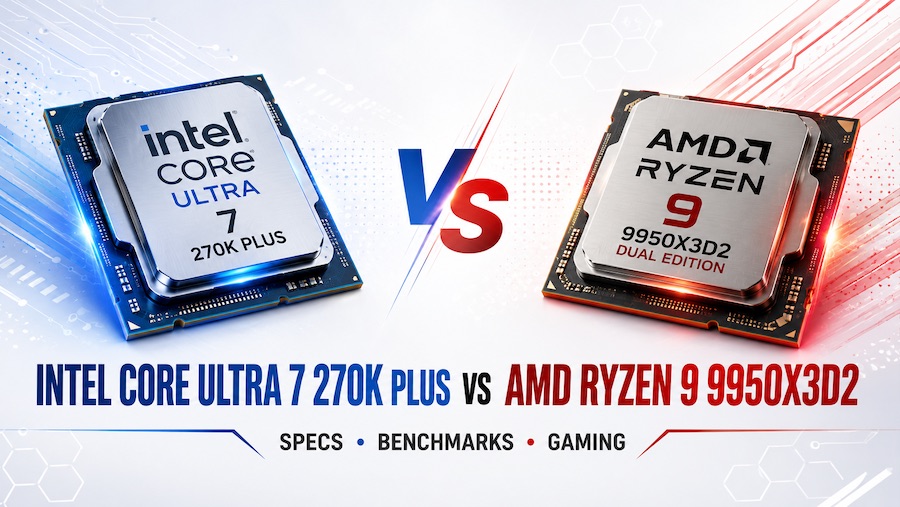
The Intel Core Ultra 7 270K Plus vs AMD Ryzen 9 9950X3D2 Dual Edition comparison is not a simple “Intel i7 vs Ryzen 9” fight. These two desktop processors are built with very different ideas. Intel is chasing strong value, high single-thread speed, more efficiency cores, faster DDR5 support, and a surprisingly powerful all-round desktop experience. AMD is going after the premium enthusiast market with 16 full Zen 5 cores, 32 threads, and a huge 3D V-Cache design that gives it a major advantage in cache-heavy workloads.
In simple words, the Core Ultra 7 270K Plus is the smarter value pick for many high-end PC builders, while the Ryzen 9 9950X3D2 Dual Edition is the more extreme flagship processor for people who want the biggest cache pool, strong rendering scores, heavy multitasking strength, and top-class performance in workloads that can really use AMD’s dual 3D V-Cache design.
Quick Verdict: Which CPU Is Better?
Choose the Intel Core Ultra 7 270K Plus if you want a high-end desktop CPU with excellent price-to-performance, strong single-thread benchmark scores, fast DDR5-7200 support, Intel Quick Sync, built-in AI Boost NPU, and lower official base power.
Choose the AMD Ryzen 9 9950X3D2 Dual Edition if you want the more premium processor with 16 cores, 32 threads, 192 MB L3 cache, 208 MB total cache, strong Blender-style rendering performance, and the best fit for cache-sensitive gaming, simulation, compiling, data-heavy development, and creator work.
Intel Core Ultra 7 270K Plus vs Ryzen 9 9950X3D2: Main Difference
The biggest difference is design philosophy. Intel uses a hybrid layout with 8 Performance cores and 16 Efficient cores, giving a total of 24 cores and 24 threads. AMD uses a classic high-end Ryzen layout with 16 Zen 5 cores and 32 threads. Intel has more physical cores on paper, but AMD has simultaneous multithreading and much more cache.
Cache is where AMD looks very different. The Ryzen 9 9950X3D2 Dual Edition has 192 MB of L3 cache and 208 MB total cache. That is far above the 36 MB Intel Smart Cache and 40 MB L2 cache on the Core Ultra 7 270K Plus. In real use, this means AMD can keep more game data, simulation data, and workload information closer to the CPU cores. This does not make every app faster, but in the right workload it can be a real advantage.
Full Specs Comparison
| Specification | Intel Core Ultra 7 270K Plus | AMD Ryzen 9 9950X3D2 Dual Edition |
|---|---|---|
| Market segment | High-end desktop | Enthusiast desktop flagship |
| Architecture / codename | Arrow Lake Refresh / Core Ultra Series 2 | Zen 5 / Granite Ridge AM5 |
| Launch / availability | Announced March 11, 2026; retail availability from March 26, 2026 | Released April 22, 2026 |
| Socket | FCLGA1851 | AM5 |
| Compatible platform | Intel 800-series motherboards | A620, B650, B650E, X670, X670E, B840, B850, X870, X870E |
| Total cores / threads | 24 cores / 24 threads | 16 cores / 32 threads |
| Core layout | 8 Performance cores + 16 Efficient cores | 16 Zen 5 cores with SMT |
| Base clock | 3.7 GHz P-core base, 3.2 GHz E-core base | 4.3 GHz base clock |
| Max boost clock | Up to 5.5 GHz max turbo | Up to 5.6 GHz max boost |
| L2 cache | 40 MB | 16 MB |
| L3 cache | 36 MB Intel Smart Cache | 192 MB |
| Total listed cache | 76 MB when combining L2 + L3 | 208 MB total cache |
| CPU process | TSMC N3B | TSMC 4nm CPU cores, TSMC 6nm I/O die |
| Base power / TDP | 125W processor base power | 200W default TDP |
| Maximum power behavior | 250W maximum turbo power | 270W PPT reported in platform comparisons |
| Memory support | Up to DDR5-7200 | DDR5-5600 with 2-DIMM configurations; lower official speed with 4-DIMM setups |
| Max memory | 256 GB | 256 GB |
| Memory channels | 2 | 2 |
| ECC support | Yes | Yes, motherboard support required |
| PCIe support | PCIe 5.0 and 4.0, up to 24 lanes | PCIe 5.0, 28 total native lanes / 24 usable lanes |
| Integrated graphics | Intel Graphics, 4 Xe-cores, up to 2.0 GHz, AV1 encode/decode, Quick Sync Video | AMD Radeon Graphics, 2 graphics cores, 2200 MHz |
| NPU / AI engine | Intel AI Boost NPU, 13 TOPS | No dedicated NPU listed for this desktop chip |
| Overclocking | Unlocked K-series processor | Unlocked, supports PBO and Curve Optimizer |
| Max operating temperature | 105°C | 95°C |
| Cooler | Strong tower cooler or liquid cooler recommended for heavy loads | Cooler not included; liquid cooler recommended for optimal performance |
| Official / suggested price | Launched from $299; Intel product database later lists $339–$349 recommended customer price | $899 SEP |
Benchmark Comparison
Benchmarks should never be read as one perfect truth. Scores change with BIOS version, motherboard, RAM speed, power limits, cooling, Windows build, game patch, and test method. Still, benchmark averages are useful because they show the general direction: Intel is very strong in single-thread speed and value, while AMD wins several heavy multi-core and cache-sensitive tests.
| Benchmark | Intel Core Ultra 7 270K Plus | AMD Ryzen 9 9950X3D2 Dual Edition | Winner |
|---|---|---|---|
| PassMark CPU Mark | 68,836 | 72,363 | AMD by about 5% |
| PassMark Single Thread | 5,079 | 4,680 | Intel by about 9% |
| CPU value score | 222.1 | 80.5 | Intel by a large margin |
| Cinebench 2024 Single | 145 | 141 | Intel by about 3% |
| Cinebench 2024 Multi | 2,482 | 2,529 | AMD by about 2% |
| Cinebench 2026 Single | 598 | 558 | Intel by about 7% |
| Cinebench 2026 Multi | 10,063 | 10,459 | AMD by about 4% |
| Geekbench 6 Single-Core | 3,750 | 3,614 | Intel by about 4% |
| Geekbench 6 Multi-Core | 27,406 | 27,110 | Intel by about 1% |
| Blender CPU score | 615.2 | 748.32 | AMD by about 22% |
Visual Benchmark Snapshot
The chart below shows each processor as a percentage of the faster chip in that specific benchmark. It makes the result easier to understand than comparing raw numbers from different benchmark types.
Gaming Performance: Which One Is Better for Games?
For gaming, the answer depends heavily on resolution, GPU, and game engine. At 1080p with a very powerful graphics card, CPU differences show more clearly. At 1440p and 4K, the GPU often becomes the bigger limit, so the real-world gap becomes smaller.
The Ryzen 9 9950X3D2 Dual Edition has the stronger gaming-focused design because of its huge 3D V-Cache. Games that love cache can benefit from having more data close to the CPU. Strategy games, simulation games, large open-world games, and some competitive titles can respond well to X3D processors.
The Intel Core Ultra 7 270K Plus is still a very capable gaming CPU. It has strong single-thread performance, a high 5.5 GHz turbo clock, and better gaming behavior than earlier Core Ultra desktop chips. In many real gaming situations, especially when playing at 1440p or 4K with high settings, it can feel very close to more expensive processors because the graphics card carries more of the load.
Gaming Example
Imagine you are building a PC with an RTX 5080 or RTX 5090. If you play esports titles at 1080p and want the highest possible frame rate, AMD’s cache can be valuable. If you play story games at 1440p or 4K, the Intel chip may deliver a very similar visible experience for much less money, especially when your GPU is the main performance limit.
Productivity and Creator Workloads
In productivity, the comparison becomes more interesting. The Ryzen 9 9950X3D2 Dual Edition is excellent when software can use its 16 Zen 5 cores, 32 threads, and large cache. This includes rendering, simulation, heavy code builds, AI-related development, and workloads where data movement matters.
The Core Ultra 7 270K Plus also performs very well in creator work, especially considering its price. Its 8 P-cores and 16 E-cores give it strong multi-core behavior, and Intel’s single-thread performance helps with everyday responsiveness. Intel Quick Sync can also be useful for video editors who work with supported codecs, making the CPU more practical than raw benchmark numbers alone might suggest.
Creator Example
A YouTuber editing 4K footage may like the Intel chip because of Quick Sync support, strong value, and lower purchase cost. A 3D artist rendering large Blender scenes or a developer compiling huge projects may prefer the Ryzen 9 9950X3D2 if the software benefits from more threads and a larger cache pool.
Power, Heat, and Cooling
The Intel Core Ultra 7 270K Plus has a 125W processor base power and a 250W maximum turbo power. That means it is not a low-power chip under heavy load, but its official base power is lower than AMD’s 200W TDP. It still deserves a good cooler, especially if you plan to run long renders, heavy multitasking, or high-power motherboard settings.
The Ryzen 9 9950X3D2 Dual Edition is more demanding. AMD recommends a liquid cooler for optimal performance, and that makes sense because this chip is built for the top end. If you buy it, do not pair it with a weak cooler or a cramped case. A quality 360mm AIO or a very strong cooling setup is the safer choice for long all-core workloads.
Platform and Upgrade Path
Platform choice matters almost as much as the CPU. The Intel Core Ultra 7 270K Plus uses LGA1851 and Intel 800-series motherboards. It is a strong chip, but the upgrade path may not be as attractive if Intel moves to a new platform quickly.
The Ryzen 9 9950X3D2 uses AMD’s AM5 socket. AM5 has been a strong platform for people who want future CPU upgrade options. If you already own a good AM5 motherboard and DDR5 RAM, moving to the 9950X3D2 can be easier than building a completely new system.
Cache Comparison: Why AMD Looks So Different
The Ryzen 9 9950X3D2’s 192 MB L3 cache is the headline feature. It does not automatically beat Intel in every test, but it gives AMD a special advantage in workloads that repeatedly access large data sets. That is why X3D processors often perform so well in games and some technical workloads even when clock speed alone does not explain the result.
Integrated Graphics and Media Work
Neither of these processors is meant to replace a real gaming graphics card. For a high-end PC, you should still use a dedicated GPU. However, integrated graphics can still matter for troubleshooting, media engines, and display output.
Intel has the stronger integrated graphics and media package here. The Core Ultra 7 270K Plus includes Intel Graphics with 4 Xe-cores, AV1 encode/decode, and Intel Quick Sync Video. That can be useful for video editing, streaming workflows, and systems where the iGPU helps with media acceleration.
AMD includes Radeon Graphics with 2 graphics cores. It is useful for display output and basic use, but it is not the main reason to buy the Ryzen 9 9950X3D2. You buy this AMD chip for CPU cores, threads, cache, and AM5 platform strength.
Real Buying Examples
Example 1: Best High-End Gaming PC Without Overspending
If you want a fast gaming PC but do not want to spend flagship money on the CPU, the Intel Core Ultra 7 270K Plus makes more sense. Put the saved money into a better graphics card, faster SSD, better monitor, or more RAM. For many gamers, that will improve the final PC more than buying the most expensive CPU.
Example 2: Premium Gaming and Heavy Creation Together
If you play CPU-heavy games and also do Blender rendering, development work, simulation, and large project builds, the AMD Ryzen 9 9950X3D2 Dual Edition is the more exciting processor. It costs much more, but it is built for users who can actually use its extra cache and 32-thread design.
Example 3: Video Editing and Streaming
For a video editing build, Intel has a practical advantage because of Quick Sync. This is especially useful when working with supported formats. AMD can still be very fast in export and rendering tasks, but Intel may give better value for editors who care about smooth workflow, media acceleration, and total system cost.
Example 4: Developer Workstation
For coding, compiling, browser-heavy multitasking, containers, and local development, both CPUs are strong. Intel gives great performance for the money. AMD becomes more attractive when your work involves huge projects, simulation, data-heavy tasks, or anything that benefits from more threads and large cache.
Related:AMD Ryzen 7 9800X3D vs 7800X3D
Pros and Cons
| CPU | Pros | Cons |
|---|---|---|
| Intel Core Ultra 7 270K Plus | Strong single-thread scores, excellent value, 24-core hybrid layout, DDR5-7200 support, Quick Sync, AV1 support, built-in NPU, lower official base power, great all-round performance. | LGA1851 upgrade path may feel limited, no Hyper-Threading, smaller cache than AMD, needs a good cooler under heavy turbo loads. |
| AMD Ryzen 9 9950X3D2 Dual Edition | Huge 192 MB L3 cache, 208 MB total cache, 16 cores and 32 threads, strong rendering and heavy workload performance, AM5 platform, excellent for cache-sensitive tasks. | Very expensive, higher power and cooling demand, not always much faster in normal gaming, needs a strong liquid cooler to perform at its best. |
Final Recommendation
The best CPU for most buyers is the Intel Core Ultra 7 270K Plus, because it gives strong high-end performance without forcing you into a very expensive flagship CPU budget. It is fast in single-thread benchmarks, competitive in multi-core tests, useful for video work, and much better in value.
The best CPU for the no-compromise enthusiast is the AMD Ryzen 9 9950X3D2 Dual Edition. It is not the sensible choice for everyone, but it is the more powerful and more specialized chip when your workload can use the 16 cores, 32 threads, and massive dual 3D V-Cache layout.
In simple buying terms: choose Intel if you want the smarter high-end deal. Choose AMD if you want the more extreme flagship and your work or games can benefit from huge cache and stronger heavy-thread performance.
FAQ
Is the Ryzen 9 9950X3D2 faster than the Intel Core Ultra 7 270K Plus?
In several heavy multi-core and rendering benchmarks, yes. The Ryzen 9 9950X3D2 is especially strong in Blender-style CPU rendering and cache-heavy workloads. However, the Intel Core Ultra 7 270K Plus can be faster in single-thread tests and offers much better value.
Which CPU is better for gaming?
The Ryzen 9 9950X3D2 has the stronger gaming-focused cache design, but the Intel Core Ultra 7 270K Plus is still very fast. At 1440p and 4K, the graphics card often matters more than the CPU, so many gamers may not feel a big difference.
Which CPU is better for video editing?
The Intel Core Ultra 7 270K Plus is very attractive for video editing because of Intel Quick Sync and strong performance for the price. The Ryzen 9 9950X3D2 can still be excellent for heavy rendering, but it costs far more.
Which CPU needs better cooling?
The Ryzen 9 9950X3D2 Dual Edition needs the stronger cooling setup. AMD recommends liquid cooling for optimal performance. The Intel chip also deserves a good cooler, but it is generally easier to manage in a value-focused high-end build.
Which CPU is better value?
The Intel Core Ultra 7 270K Plus is clearly the better value choice. The Ryzen 9 9950X3D2 is a premium flagship processor and only makes sense if you truly need its cache, threads, and top-end workload performance.
Data note: Benchmark scores are useful for comparison, but real-world performance changes with motherboard, BIOS, RAM speed, cooler, power limits, graphics card, operating system, and software version.