
AMD Ryzen 7 9800X3D vs 7800X3D: Benchmarks, Specs, Gaming Performance, and Best Value
AMD Ryzen 7 9800X3D vs 7800X3D specs comparison
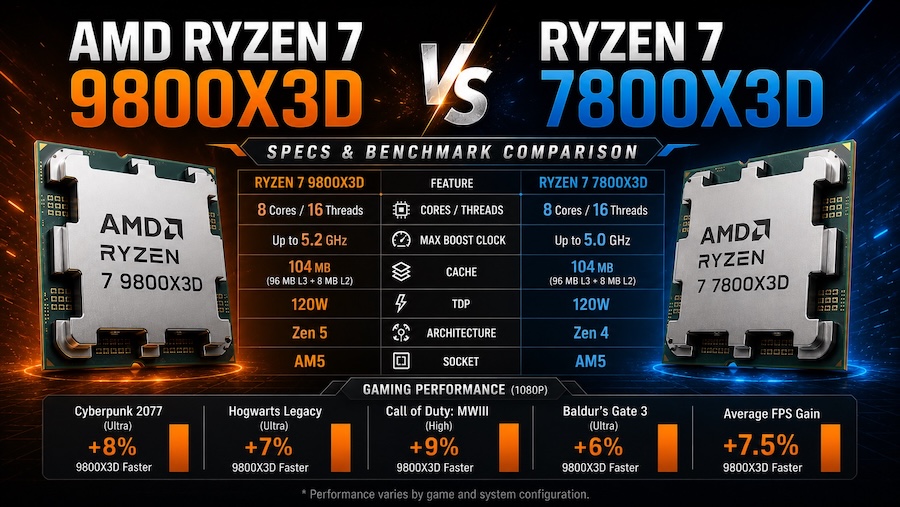
Both chips are 8-core, 16-thread AM5 processors with 96 MB of L3 cache, but the Ryzen 7 9800X3D is built on the newer Zen 5 architecture and uses a newer 3D V-Cache layout. The 7800X3D is based on Zen 4 and was already famous for excellent gaming performance and efficiency.
| Specification | Ryzen 7 9800X3D | Ryzen 7 7800X3D | Difference |
|---|---|---|---|
| Architecture | Zen 5 | Zen 4 | 9800X3D uses the newer architecture. |
| Cores / Threads | 8 cores / 16 threads | 8 cores / 16 threads | Tied. |
| Base Clock | 4.7 GHz | 4.2 GHz | 9800X3D is about 11.9% higher. |
| Max Boost Clock | Up to 5.2 GHz | Up to 5.0 GHz | 9800X3D is about 4.0% higher. |
| L3 Cache | 96 MB | 96 MB | Tied in L3 cache size. |
| L2 Cache | 8 MB | 8 MB | Tied. |
| L1 Cache | 640 KB | 512 KB | 9800X3D has more L1 cache. |
| Default TDP | 120W | 120W | Tied on official TDP. |
| CPU Core Process | TSMC 4nm FinFET | TSMC 5nm FinFET | 9800X3D uses a newer CPU core process. |
| I/O Die Process | TSMC 6nm FinFET | TSMC 6nm FinFET | Tied. |
| Socket | AM5 | AM5 | Both use the same platform. |
| PCIe Version | PCIe 5.0 | PCIe 5.0 | Tied. |
| Native PCIe Lanes | 28 total / 24 usable | 28 total / 24 usable | Tied. |
| Official Memory Support | DDR5-5600 with 2 sticks, depending on configuration | DDR5-5200 with 2 sticks, depending on configuration | 9800X3D has a higher official memory speed rating. |
| Maximum Memory | 256 GB | 128 GB | 9800X3D lists a higher maximum memory capacity. |
| Integrated Graphics | AMD Radeon Graphics, 2 graphics cores, 2200 MHz | AMD Radeon Graphics, 2 graphics cores, 2200 MHz | Tied. Good for display output and troubleshooting, not serious gaming. |
| Maximum Operating Temperature | 95°C | 89°C | Different thermal limits; cooler quality still matters for both. |
| Box Cooler | Not included | Not included | Both need a separate CPU cooler. |
Comparative view chart
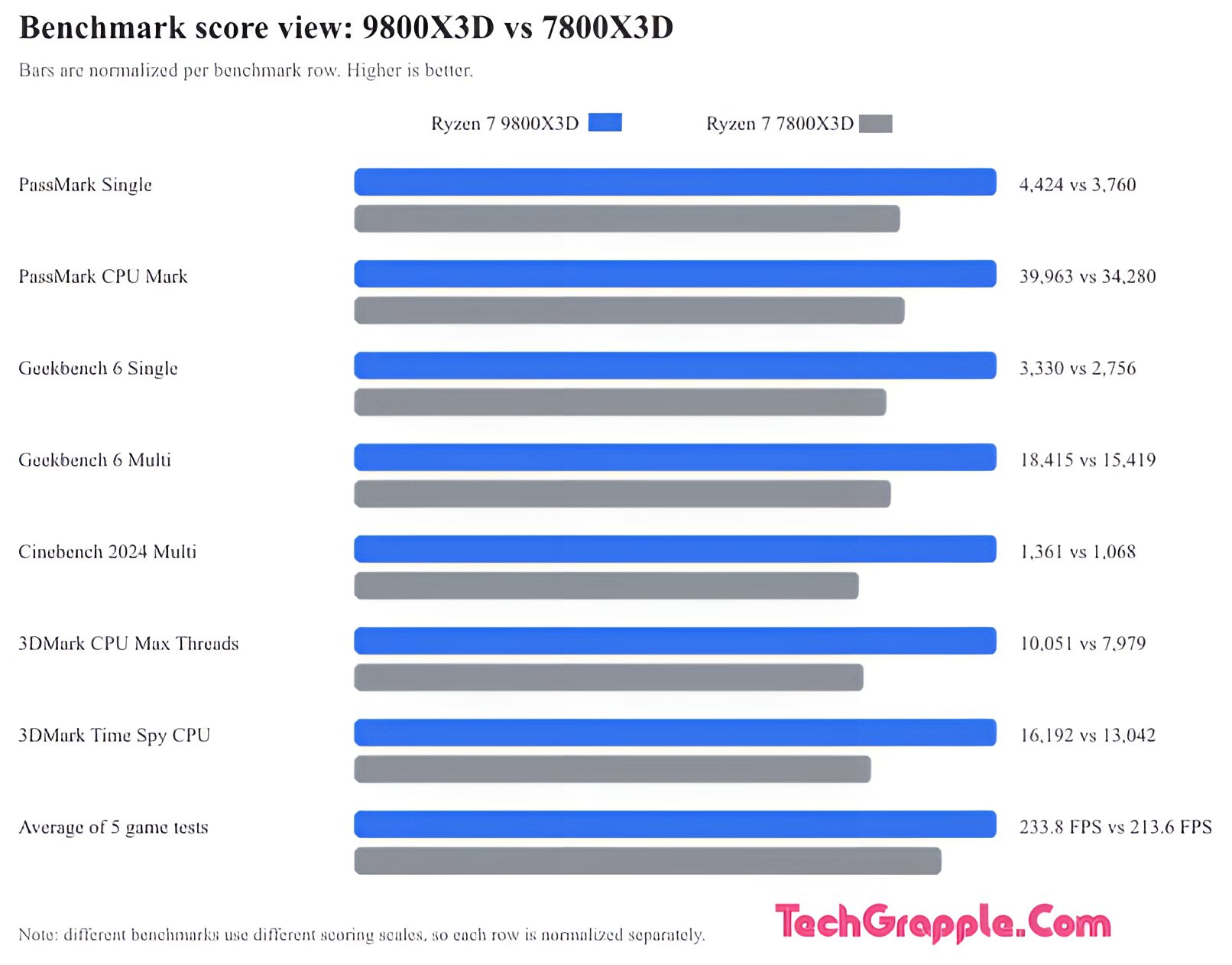
The chart below normalizes every row separately. In each benchmark row, the Ryzen 7 9800X3D is treated as the 100% reference bar, and the Ryzen 7 7800X3D bar shows how close it gets in that same test.
AMD Ryzen 7 9800X3D vs 7800X3D benchmark scores
For most buyers, benchmarks are the first thing that matters. The Ryzen 7 9800X3D is not just a small clock-speed refresh. It moves from Zen 4 to Zen 5, uses AMD’s second-generation 3D V-Cache design, has a higher base clock, and sustains stronger performance in many CPU-heavy workloads.
Important benchmark note: CPU benchmark scores change with motherboard BIOS, Windows version, RAM speed, cooling, graphics card, power settings, and game updates. The numbers below are best used as a clear comparison guide, not as a promise that every PC will score exactly the same.
| Benchmark | Ryzen 7 9800X3D | Ryzen 7 7800X3D | 9800X3D difference | What it means |
|---|---|---|---|---|
| PassMark Single Thread Rating | 4,424 | 3,760 | +17.7% | Better for games, app responsiveness, browser speed, and lightly threaded work. |
| PassMark CPU Mark | 39,963 | 34,280 | +16.6% | A public average showing stronger overall CPU performance. |
| Geekbench 6 Single-Core | 3,330 | 2,756 | +20.8% | A strong single-core uplift from Zen 5 and higher clocks. |
| Geekbench 6 Multi-Core | 18,415 | 15,419 | +19.4% | Better for mixed workloads that can use all 8 cores and 16 threads. |
| Cinebench 2024 Single-Core | 132 | 114 | +15.8% | Useful for understanding raw CPU rendering performance per core. |
| Cinebench 2024 Multi-Core | 1,361 | 1,068 | +27.4% | The 9800X3D is much stronger in heavier creator-style CPU workloads. |
| 3DMark CPU Profile Max Threads | 10,051 | 7,979 | +26.0% | Shows a big gain in a CPU-focused 3DMark test. |
| 3DMark CPU Profile Single Thread | 1,213 | 963 | +26.0% | Another sign that Zen 5 improves per-thread performance. |
| 3DMark Time Spy CPU Score | 16,192 | 13,042 | +24.2% | Good for CPU-heavy gaming simulation inside the 3DMark test. |
| Average of 5 game tests listed below | 233.8 FPS | 213.6 FPS | +9.5% | Gaming uplift is real, but smaller than synthetic CPU benchmark gains. |
Gaming benchmarks: where the Ryzen 7 9800X3D actually feels faster
In gaming, the Ryzen 7 9800X3D is faster, but the size of the upgrade depends heavily on the game and resolution. At 1080p with a very powerful graphics card, the CPU difference is easier to see. At 1440p or 4K, the graphics card often becomes the bigger limit, so the gap between these two CPUs can shrink.
| Game test | Ryzen 7 9800X3D | Ryzen 7 7800X3D | Difference | Simple meaning |
|---|---|---|---|---|
| Metro Exodus | 241 FPS | 212 FPS | +13.7% | A clear gain, especially for high-refresh gaming. |
| Forza Motorsport 2023 | 198 FPS | 185 FPS | +7.0% | Noticeable, but not a night-and-day difference. |
| Shadow of the Tomb Raider | 380 FPS | 346 FPS | +9.8% | Strong result for CPU-sensitive high-FPS gaming. |
| Cyberpunk 2077 | 249 FPS | 225 FPS | +10.7% | The faster chip helps in a heavy open-world title. |
| Black Myth: Wukong | 101 FPS | 100 FPS | +1.0% | Almost tied here, likely because the test is less CPU-limited. |
| Average of these 5 tests | 233.8 FPS | 213.6 FPS | +9.5% | The 9800X3D wins, but the 7800X3D is still very strong. |
These game examples show why the 9800X3D is attractive for new high-end builds. If you play competitive shooters, simulation games, strategy games, or big open-world games with a high-end GPU, the newer chip can give you higher average FPS and sometimes smoother lows. But the Ryzen 7 7800X3D is not suddenly weak. It remains a very fast gaming CPU, and in many GPU-limited situations, both processors can feel very close.
3DMark and graphics score: important clarification
A CPU does not create high-end 3D graphics by itself. In a gaming PC, the graphics card does most of the 3D rendering. That is why CPU-focused 3DMark results and graphics-focused 3DMark results should be read differently.
| 3D / graphics-related test | Ryzen 7 9800X3D | Ryzen 7 7800X3D | Difference | How to read it |
|---|---|---|---|---|
| 3DMark Time Spy CPU Score | 16,192 | 13,042 | +24.2% | This is CPU-focused, so the 9800X3D shows a big uplift. |
| 3DMark CPU Profile Max Threads | 10,051 | 7,979 | +26.0% | Another CPU-focused test where Zen 5 pulls ahead. |
| 3DMark.com Time Spy CPU Score with RX 7900 XTX | 15,114 | 12,562 | +20.3% | A public same-GPU comparison showing the newer CPU ahead. |
| 3DMark.com Time Spy Graphics Score with RX 7900 XTX | 33,512 | 33,618 | -0.3% | Basically tied, because the graphics score mostly depends on the GPU. |
| 3DMark.com Time Spy Overall Score with RX 7900 XTX | 28,337 | 26,863 | +5.5% | Overall system score improves, but less than the CPU-only score. |
This is why a buyer should not expect the 9800X3D to magically make a weak GPU behave like a high-end graphics card. The 9800X3D helps the CPU side of gaming: game logic, simulation, draw calls, frame pacing, and high-FPS situations. For 4K ultra settings, ray tracing, and heavy visual effects, the GPU still matters more.
What changed from Ryzen 7 7800X3D to Ryzen 7 9800X3D?
The biggest change is not the core count. Both CPUs have 8 cores and 16 threads. The real change is the design around those cores. The Ryzen 7 9800X3D uses Zen 5, higher clock speeds, and a second-generation 3D V-Cache layout. AMD moved the extra cache below the processor cores, which helps the cores sit closer to the cooling solution. In simple words, the newer chip can run its cores faster and more freely than the earlier X3D design.
The Ryzen 7 7800X3D is still special because it brought huge gaming performance to a simple 8-core chip. It does not need 12 or 16 cores to be fast in games. Its large L3 cache helps the CPU keep more game data close to the cores, which reduces waiting and can improve frame rates. This is why the 7800X3D remained popular for so long, even against CPUs with higher clocks or more cores.
The Ryzen 7 9800X3D keeps that same gaming idea but removes some of the older limitations. It has a 4.7 GHz base clock compared with 4.2 GHz on the 7800X3D. Its maximum boost is also higher at up to 5.2 GHz compared with up to 5.0 GHz. The boost difference may look small, but the total result is larger because Zen 5 also improves work done per clock.
Release date and initial launch price
Launch price is useful for historical comparison, but it should not be treated as the current price. CPU prices change with stock, region, sales, bundles, and newer product launches. Always check the live price before buying.
| CPU | Launch date | Initial launch price | Price note |
|---|---|---|---|
| AMD Ryzen 7 9800X3D | November 7, 2024 | $479 launch SEP / starting price | This was the initial launch price. Current street price can be different. |
| AMD Ryzen 7 7800X3D | April 6, 2023 | $449 launch price | This was the initial launch price. Current street price can be different. |
At launch, the Ryzen 7 9800X3D cost $30 more than the Ryzen 7 7800X3D’s launch price. That is about a 6.7% higher launch price. In many CPU benchmarks, the 9800X3D is more than 15% faster, so the performance increase is bigger than the launch-price increase. However, the real-world buying decision depends on today’s price, not only launch price. If the 7800X3D is heavily discounted, it can still be the better value for many gamers.
Single-core performance: 9800X3D is clearly ahead
Single-core performance matters because many everyday tasks still depend on one strong thread at a time. This includes opening apps, loading parts of games, browser responsiveness, some older games, and parts of creative software.
In PassMark Single Thread, the Ryzen 7 9800X3D scores 4,424 while the Ryzen 7 7800X3D scores 3,760. That makes the 9800X3D about 17.7% faster. In Geekbench 6 single-core, the 9800X3D scores 3,330 while the 7800X3D scores 2,756, giving the newer CPU about a 20.8% lead. In Cinebench 2024 single-core, it is 132 versus 114, or about 15.8% ahead.
This is one of the main reasons the 9800X3D feels better outside pure gaming. The 7800X3D is excellent for games, but its lower clocks and older architecture make it less impressive in some productivity and single-threaded tests. The 9800X3D fixes much of that weakness.
Multi-core performance: the 9800X3D is a stronger all-rounder
Multi-core performance matters for rendering, encoding, compression, development tools, multitasking, and some heavier creator workflows. Neither of these CPUs is a 16-core workstation monster, but the 9800X3D does a much better job of balancing gaming performance with productivity performance.
The Geekbench 6 multi-core score is 18,415 for the 9800X3D and 15,419 for the 7800X3D, which makes the 9800X3D about 19.4% faster. Cinebench 2024 multi-core shows an even bigger gap: 1,361 versus 1,068, or about 27.4% faster for the 9800X3D. In 3DMark CPU Profile Max Threads, the 9800X3D scores 10,051 while the 7800X3D scores 7,979, a 26.0% advantage.
This matters if your PC is not only a gaming machine. If you also edit videos, work with large photo projects, compile code, stream, record gameplay, or run many apps at the same time, the Ryzen 7 9800X3D is the more comfortable choice.
Power, thermals, and cooling
Both CPUs have a 120W default TDP, and both ship without a cooler. That means you should budget for a good air cooler or a liquid cooler, especially if you want quiet operation. The Ryzen 7 7800X3D is known for being very efficient in gaming. The Ryzen 7 9800X3D can draw more power in heavy workloads because it runs higher clocks and is more aggressive.
In real use, that means the 7800X3D can be easier to cool in many gaming builds, while the 9800X3D can use its extra thermal headroom to push higher performance. For a small case, quiet PC, or budget cooler, the 7800X3D still has a charm. For a premium build with a strong cooler, the 9800X3D makes more sense.
Motherboard and RAM compatibility
Both processors use AMD’s AM5 socket and DDR5 memory. That is good news for upgraders who already have a compatible AM5 motherboard. However, the Ryzen 7 9800X3D may require a BIOS update on older AM5 motherboards. Before buying, check your motherboard support page and confirm the BIOS version that supports the 9800X3D.
For RAM, DDR5-6000 is commonly treated as a sweet spot for many AM5 gaming builds, although official memory support ratings are lower and depend on the number of sticks and memory rank. The 9800X3D officially lists DDR5-5600 support with two sticks in common configurations, while the 7800X3D lists DDR5-5200. Many users run EXPO memory kits, but stability depends on the motherboard, BIOS, and memory kit.
Real-world examples: which CPU makes more sense?
-
Example 1: You are building a new high-end gaming PC.
Choose the Ryzen 7 9800X3D if the price difference is reasonable. It is faster in CPU benchmarks, faster in most gaming tests, and better for non-gaming tasks. -
Example 2: You already own a Ryzen 7 7800X3D.
Upgrading to the 9800X3D is not necessary for every gamer. If you play at 1440p or 4K and your GPU is the main limit, the upgrade may not feel huge. If you chase very high FPS at 1080p or play CPU-heavy games, it becomes more tempting. -
Example 3: You mostly play esports games on a high-refresh monitor.
The 9800X3D is the better performance pick. Games that benefit from strong single-thread speed, low latency, and high frame pacing can make better use of the newer CPU. -
Example 4: You want the best value and find the 7800X3D much cheaper.
The 7800X3D can still be the smarter buy. It remains extremely fast in games and can free up budget for a stronger GPU, better monitor, or larger SSD. -
Example 5: You game and also do creator work.
The 9800X3D is the better balanced chip. Its multi-core and single-core improvements make it feel less like a gaming-only processor.
Ryzen 7 9800X3D vs 7800X3D: which one should you buy?
Choose the Ryzen 7 9800X3D if you want the faster CPU, you are building a new premium AM5 gaming PC, you care about high-refresh gaming, or you also use your computer for productivity. It is the stronger all-rounder and fixes one of the main complaints about the 7800X3D: weaker productivity performance compared with non-X3D or higher-core CPUs.
Choose the Ryzen 7 7800X3D if the price is much lower, your main goal is gaming, and you would rather spend more of your budget on the graphics card. It is still a brilliant gaming CPU. In many real gaming setups, especially at higher resolutions, the GPU will matter more than the difference between these two processors.
The best value decision comes down to the price gap. If the 9800X3D costs only a little more, it is easy to recommend. If the 7800X3D is heavily discounted, it can still be the better deal for pure gaming.
Final verdict
The AMD Ryzen 7 9800X3D is clearly faster than the Ryzen 7 7800X3D. It wins in single-core benchmarks, multi-core benchmarks, CPU-focused 3DMark tests, and most game tests. It is not just a small upgrade on paper; it is a better balanced X3D processor that keeps elite gaming performance while improving productivity performance.
However, the Ryzen 7 7800X3D still deserves respect. It remains one of the most efficient and capable gaming CPUs on AM5, and it can still be a smart buy when discounted. For gamers who already own it, the 9800X3D is an upgrade, but not always a must-have upgrade. For new buyers choosing between the two today, the Ryzen 7 9800X3D is the better CPU, while the Ryzen 7 7800X3D can be the better value if the price difference is large enough.
FAQ: AMD Ryzen 7 9800X3D vs 7800X3D
Is the Ryzen 7 9800X3D faster than the 7800X3D?
Yes. In the benchmark set used here, the 9800X3D is around 16% to 27% faster in many CPU tests and around 9.5% faster across the five listed game tests.
Is the Ryzen 7 9800X3D worth upgrading from a 7800X3D?
It depends on your use. If you already own a 7800X3D and mostly play at 1440p or 4K, the upgrade may not feel dramatic. If you play CPU-heavy games, use a very high-refresh monitor, or also do productivity work, the 9800X3D is more attractive.
Do both CPUs work on AM5 motherboards?
Yes, both are AM5 CPUs. The 9800X3D may need a BIOS update on older AM5 motherboards, so check the motherboard support page before installing it.
Do the Ryzen 7 9800X3D and 7800X3D have integrated graphics?
Yes, both include basic AMD Radeon Graphics with 2 graphics cores. This is useful for display output and troubleshooting, but these integrated graphics are not meant to replace a proper gaming GPU.
Which CPU is better for gaming?
The Ryzen 7 9800X3D is the faster gaming CPU overall. The Ryzen 7 7800X3D is still excellent and can be a better value if it is much cheaper.
Which CPU is better for video editing and productivity?
The Ryzen 7 9800X3D is better for productivity. It has stronger single-core and multi-core scores, making it more suitable for mixed gaming and work builds.
Data note: Benchmark scores in this article are based on publicly available review and benchmark database results checked on June 22, 2026. Prices listed as launch prices are historical starting prices only. Current retail prices can be different.